How to Make Cold Brew Coffee
Make smooth cold brew at home: the right ratio for concentrate or ready-to-drink, how long to steep (backed by research), how to strain, store and serve it, plus a calculator.

Ratios and timings follow established specialty-coffee recipes, credited in the brew widget. How we test · Editorial policy
Cold brew is coffee made with time instead of heat: coarse grounds steeped in cold water for 12–18 hours, then strained. The result is smooth, chocolatey and naturally sweet, with almost no bitterness. It keeps in the fridge for days, and it costs a fraction of the café version. Here’s how to make it, how strong to make it, and what the science says about how long to steep it.
- Concentrate: 1 part coarse coffee to 5 parts cold water (100 g of coffee to 500 g of water), then dilute 1:1 to drink.
- Ready to drink: 1:8 (100 g to 800 g), poured straight over ice.
- Steep in the fridge for 12–18 hours. Overnight is perfect.
- Strain twice: through a sieve, then a paper coffee filter.
- Keeps for about a week (concentrate) or 3–4 days (ready to drink), sealed and cold.
The calculator at the top of this page works out the coffee and water for however many glasses you want, for both styles.
What cold brew is (and isn’t)
Cold brew is never heated. The coffee steeps in cold or room-temperature water for many hours, and the long, slow brew pulls out the sweet, chocolatey compounds but far fewer of the sharp acids and bitter notes that hot water extracts. That’s why it tastes so smooth.
| Cold brew | Iced coffee | |
|---|---|---|
| How it’s made | Steeped cold for 12–18 hours | Brewed hot, then chilled or poured over ice |
| Taste | Smooth, round, chocolatey, low bitterness | Brighter and more aromatic, with more acidity |
| Ready in | Overnight | Five minutes |
| Keeps | Days in the fridge | Best fresh |
Want iced coffee in five minutes instead? Brew a pour over straight onto ice. Our pour over guide shows how.
Cold brew ratio: concentrate or ready to drink
Cold water extracts slowly, so cold brew uses much more coffee than hot coffee: anywhere from 1:4 to 1:10. There are two ways to go:
- Concentrate (1:4–1:5): a strong base you dilute when serving. It takes up less space in the fridge, keeps longer, and you can make each glass as strong as you like. It’s also great with milk.
- Ready to drink (1:8–1:10): brewed at drinking strength, so you just pour it over ice.
Plan for the water the grounds soak up. Wet coffee grounds hold about twice their weight in water. With so much coffee in a cold brew, that’s a lot: 100 g of coffee and 500 g of water gives you only about 300 ml of concentrate. Our table and calculator take this into account:
| Glasses (~250 ml) | Concentrate 1:5 | Ready to drink 1:8 |
|---|---|---|
| 2 | 84 g coffee + 420 g water | 83 g coffee + 660 g water |
| 4 | 168 g coffee + 840 g water | 165 g coffee + 1.3 liters water |
| 8 | 336 g coffee + 1.7 liters water | 330 g coffee + 2.6 liters water |
For other brew methods, see our coffee-to-water ratio guide.
How to make cold brew, step by step
This makes about four glasses of concentrate-based cold brew: 168 g of coffee and 840 g of cold water. You need a large jar or pitcher, a fine sieve and a paper coffee filter. A French press works well too.
1. Grind coarse
Grind the coffee coarse, like coarse sea salt or raw sugar, the same as for a French press. Fine grounds make cold brew muddy and hard to strain, and can turn it bitter. Pre-ground coffee works, but expect a cloudier brew. See our grind chart.
2. Combine and stir
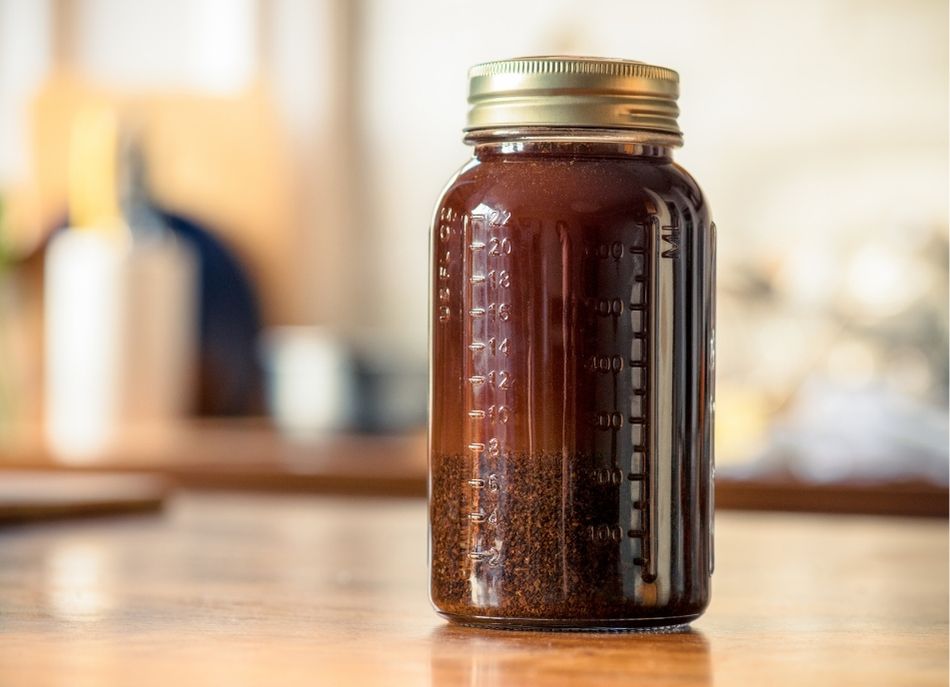
Put the coffee in the jar and pour in cold, filtered water. Stir gently until every ground is wet. Dry clumps floating on top don’t brew. Check again after a few minutes and push down any grounds that float back up.
3. Steep in the fridge for 12–18 hours
Cover it and leave it in the fridge. Set it up after dinner and it’s ready by morning. There’s no need to stir it while it steeps.
4. Strain twice
Pour it through a fine sieve to catch the grounds. Then pour it again through a paper coffee filter, such as a pour over or drip-machine filter in a funnel, to remove the fine silt. This second strain is slow, but it’s what makes cold brew clean and silky instead of muddy. Don’t squeeze the grounds: it pushes bitterness and sediment through.
5. Dilute, serve and store
Fill a glass with ice and add 1 part concentrate to 1 part water or milk. Use more concentrate for a stronger drink, or more water for a lighter one. Pour the rest into a clean bottle, seal it and keep it in the fridge.

How long should cold brew steep?
Most recipes say 12–24 hours, but the chemistry says less is needed than you’d think. Researchers at Thomas Jefferson University measured cold brew as it steeped. Caffeine and chlorogenic acid (one of coffee’s main flavour and antioxidant compounds) stopped increasing after just 6–7 hours. To see how much caffeine your glass has, try our caffeine calculator.
Flavour is more than those two compounds, though, and in the cold of a fridge, extraction is slower again. In practice:
- In the fridge: 12–18 hours. This is the sweet spot for a full, chocolatey flavour.
- At room temperature: 8–12 hours. It’s faster, but bacteria can grow in coffee left out for long periods, so the fridge is the safer choice, especially in a warm kitchen.
- Over 24 hours: the extra time rarely helps. It tends to bring out woody, papery and bitter notes.
Best coffee for cold brew
Medium roasts are the best all-rounders. The same study found that medium roasts gave cold brew more caffeine and chlorogenic acid than dark roasts. Chocolatey, nutty coffees from Brazil, Colombia or Guatemala make the classic smooth, sweet cold brew. For something different, try a fruity natural-process Ethiopian: it makes a cold brew that tastes like blueberries and dark chocolate. Very dark roasts work, but they can taste flat and ashy when cold.
Is cold brew less acidic, stronger or healthier?
There are plenty of myths here, so here’s what the research says:
- Acidity: cold brew isn’t meaningfully lower in pH. A 2018 study in Scientific Reports found that hot and cold brew both measure about pH 4.85–5.13. What cold brew has less of is total acid, which is why it tastes smoother and less sharp. Some people with sensitive stomachs find it easier to drink, but it isn’t acid-free.
- Antioxidants: the same study found that hot coffee has more antioxidant activity than cold brew.
- Caffeine: it depends on how much coffee you use. Undiluted concentrate is very strong, so it’s easy to drink a lot of caffeine without noticing. Diluted 1:1, a glass is roughly as strong as a mug of hot coffee.
How long does cold brew last?
- Concentrate: about 7 days, and up to 2 weeks at the most, in a sealed bottle in the fridge. It tastes best in the first week.
- Ready-to-drink or diluted cold brew: 3–4 days.
- With milk added: drink it the same day.
Use clean jars, keep it cold, and pour it out if it smells sour or musty, or looks cloudy or slimy. To save it for longer, freeze the concentrate in an ice-cube tray. The cubes are also great for chilling iced coffee without watering it down.
Troubleshooting
| Problem | Likely cause | Try this |
|---|---|---|
| Weak, watery | Not enough coffee, too short a steep, or diluted too much | Use 1:5 for concentrate. Steep at least 12 hours in the fridge. Dilute less. |
| Bitter, harsh | Grind too fine, steeped too long, or the grounds were squeezed | Grind coarser. Steep 12–18 hours. Let it drain without pressing. |
| Woody, papery, stale | Steeped over 24 hours, or old coffee | Shorten the steep. Use coffee roasted within the last month. |
| Sour, thin | Under-extracted: a very light roast or a short, cold steep | Steep longer, or switch to a medium roast. |
| Muddy, gritty | Fine particles got through | Strain a second time through a paper filter. |
| Flat after a few days | Oxidation | Store sealed, with little air in the bottle, and drink within a week. |
Ways to drink it
- Classic: concentrate and water, 1:1, over plenty of ice.
- Cold brew latte: concentrate and milk (or oat milk), 1:1.
- Cold brew tonic: 60 ml of concentrate over ice, topped with 120 ml of tonic water and a slice of orange.
- Hot: yes, really. Mix the concentrate 1:1 with just-boiled water for a smooth, low-bitterness hot coffee in seconds.
For more ideas, browse our coffee recipes.
Cold brew FAQ
For a concentrate, 1:5: 100 g of coarse coffee to 500 g of cold water, diluted 1:1 when you serve it. For cold brew you can drink straight over ice, use 1:8. Anything from 1:4 to 1:10 works, depending on how strong you like it.
It depends on the ratio, not the method. Undiluted concentrate has a lot of caffeine per sip, but once it’s diluted 1:1 a glass is roughly comparable to a mug of hot coffee. Caffeine extracts well in cold water: lab tests found it reaches its maximum within about 6–7 hours.
Yes. It extracts faster (8–12 hours is enough), but coffee left out for a long time can grow bacteria, especially in a warm kitchen. Steeping in the fridge for 12–18 hours is the safer choice, and it tastes just as good.
You can, but pre-ground coffee is usually ground for drip machines, finer than ideal. The cold brew will be cloudier and harder to strain, and it can taste a little bitter. Shorten the steep to about 12 hours and strain it through a paper filter.
It tastes less acidic, but its pH is about the same. A 2018 study found hot and cold brew both measure around pH 4.85–5.13. Cold brew has less total acid, which makes it taste smoother and less sharp.
Yes. Mix the concentrate 1:1 with just-boiled water for a quick, smooth hot coffee, or warm it gently in a pan. Don’t boil it, as that brings out bitterness.
Usually because the grind is too fine, it steeped too long (over 24 hours), or the grounds were squeezed while straining. Grind coarse, steep for 12–18 hours in the fridge, and let it drain on its own.
Sources
- Fuller M. & Rao N.Z., The Effect of Time, Roasting Temperature, and Grind Size on Caffeine and Chlorogenic Acid Concentrations in Cold Brew Coffee, Scientific Reports (2017).
- Rao N.Z. & Fuller M., Acidity and Antioxidant Activity of Cold Brew Coffee, Scientific Reports (2018).
- National Coffee Association, Cold brew coffee (ratio and grind).
- Cordoba N. et al., Effect of grinding, extraction time and type of coffee on the physicochemical and flavour characteristics of cold brew coffee, Scientific Reports (2019).
How we work: how we test · editorial policy · research & sources.
Published · Last updated


