How to Make Turkish Coffee
Make real Turkish coffee in a cezve: how much coffee and water per cup, sugar levels, how to get a thick foam without boiling, the specialty method, and serving traditions.

Ratios and timings follow established specialty-coffee recipes, credited in the brew widget. How we test · Editorial policy
Turkish coffee is the oldest way of brewing coffee still in everyday use: superfine coffee, water and (if you like) sugar, slowly heated in a small pot called a cezve until a thick foam rises. It’s unfiltered, so it’s rich and velvety, and it’s served with the grounds settled at the bottom of the cup. The method is simple. The craft is all in the heat and the foam, and this guide shows you how to get both right.
- Per cup: 7 g (one heaped teaspoon) of powder-fine coffee and 70 ml of cold water (about 1:10).
- Sugar goes in at the start. You can’t stir it in later without ruining the foam.
- Stir once, while it’s cold, then never again.
- Low heat, 2–4 minutes. Take it off as the foam rises, before it boils.
- Serve with a glass of water, and let it settle for a minute before sipping.
The brew guide at the top of this page scales the recipe for 1–4 cups and walks you through each step. It includes a timed recipe for the specialty method.
What you need
- A cezve (also called an ibrik or džezva). Copper is traditional because it heats evenly. Stainless steel works too, and some are made for induction. Pick a size that matches the number of cups you’ll usually make. A pot that’s too big spreads the coffee thin, and the foam won’t build.
- Turkish-grind coffee: as fine as flour or powdered sugar, finer than espresso. Most home burr grinders can’t go this fine, so either use a Turkish hand mill or buy fresh Turkish-ground coffee from a roaster or a Turkish grocery. Buy small packs: powder goes stale fast.
- Small cups (fincan), about 60–75 ml. Espresso cups are a good substitute.
- A teaspoon, and sugar if you like it sweet.
How much coffee and water
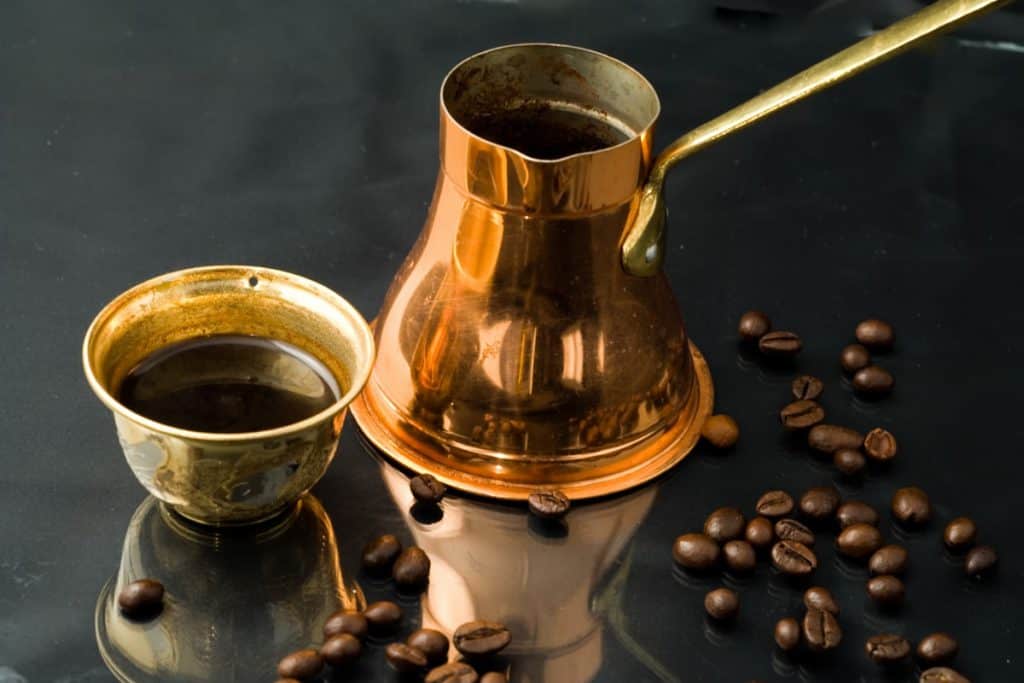
The classic measure is one heaped teaspoon of coffee per cup, with the water measured in the cup you’ll serve it in. By weight that’s about 7 g of coffee to 70 ml of water, a ratio of about 1:10. Specialty Turkish coffee brewers work between 1:8 (stronger) and 1:12 (lighter).
| Cups | Cold water | Coffee | Sugar (optional) |
|---|---|---|---|
| 1 | 70 ml | 7 g · 1 heaped tsp | 0–2 tsp |
| 2 | 140 ml | 14 g · 2 heaped tsp | 0–4 tsp |
| 3 | 210 ml | 21 g · 3 heaped tsp | 0–6 tsp |
| 4 | 280 ml | 28 g · 4 heaped tsp | 0–8 tsp |
How sweet? In Turkey you order your sugar level along with the coffee, because it’s cooked in:
- Sade: plain, no sugar.
- Az şekerli: a little sugar, about ½ teaspoon per cup.
- Orta şekerli: medium sweet, about 1 teaspoon.
- Şekerli: sweet, about 2 teaspoons.
How to make Turkish coffee, step by step
This is the traditional method for two cups: 140 ml of cold water and 14 g of coffee.
1. Measure the water with your cups
Fill your serving cups with cold water and pour it into the cezve. Measuring with the cups means each cup ends up full. Use good, filtered water, because nothing gets filtered out afterwards.
2. Add coffee and sugar, then stir once
Add one heaped teaspoon of coffee per cup, plus sugar if you’re using it. Stir gently until the coffee sinks and there are no dry clumps on top. This is the only stir. From here on, stirring breaks the foam.
3. Heat slowly
Put the cezve on low-to-medium heat. Use the smallest gas burner, or about a third of the dial on an electric hob. It should take about 3–4 minutes to come up. Slow heating gives the coffee time to brew and builds a fine, thick foam. Rushed coffee tastes harsh and has big, short-lived bubbles.
4. Watch the foam, and stop before it boils
First a dark ring of foam forms around the edge, then it spreads across the surface and starts to swell. As soon as the foam rises towards the rim, take the cezve off the heat. Don’t let it boil: boiling collapses the foam and makes the coffee bitter. If you like, spoon a little foam into each cup now.
Pro tip: many home recipes say to bring the coffee “up” three times. That makes it hotter and stronger, but it costs you foam. If you do it, lift the pot off the instant the foam rises each time, and never let it boil.
5. Pour slowly and let it settle
Pour slowly from a little height, sharing the foam between the cups. Tilting the cup helps keep it. Wait a minute or two for the grounds to settle. Then sip from the top and stop when you reach the thick layer at the bottom.
6. Serve the Turkish way
Serve each cup with a glass of water, sipped first to refresh the palate, and something sweet, traditionally a piece of lokum (Turkish delight). There’s an old saying: “a cup of coffee commits one to forty years of friendship”.
The specialty method: sweeter and more consistent
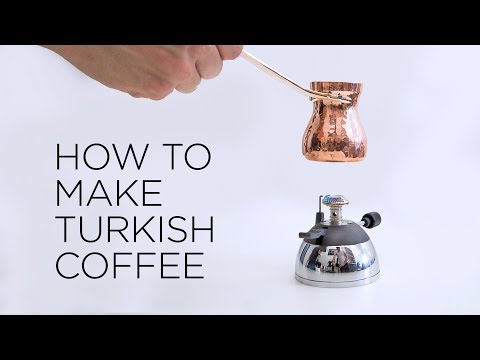
Specialty Turkish coffee baristas have refined the classic method with a few measured tweaks. It’s the Specialty recipe in our timer:
- Weigh it: 7 g of coffee to 70 g of water per cup.
- Start with warm water, about 60 °C, so the brew time is easier to control.
- Grind a touch coarser than traditional powder, but still much finer than espresso, and grind just before brewing.
- Time the brew to 2–2½ minutes: medium heat, turned down halfway through, and off the heat as the foam reaches the rim.
The result is a cleaner, sweeter cup that tastes of the coffee rather than the roast. It’s well worth trying with a good medium-roast single origin.
Which coffee to use
Traditional Turkish coffee is usually a medium roast, often Brazilian arabica, ground to powder. A very dark roast tastes ashy and bitter here. Because nothing is filtered out, freshness matters even more than usual. Turkish-ground coffee loses its aroma within a couple of weeks of opening, so buy small and keep it airtight, away from heat and light. To spice it, add a crushed cardamom pod with the coffee, the way it’s often done in Armenian and Arabic styles.
Troubleshooting
| Problem | Likely cause | Try this |
|---|---|---|
| No foam, or thin foam | Heat too high, stirring during heating, stale coffee, or a grind that’s too coarse | Use lower heat. Stir only at the start. Use fresh, powder-fine coffee. |
| Foam disappears | It boiled, or it was poured too fast | Take it off as the foam rises. Pour slowly from a little height. |
| Bitter, burnt | Boiled, too much heat, or a very dark roast | Stop before the boil. Use a medium roast. |
| Weak, watery | Not enough coffee, or the grind is too coarse | Use a heaped teaspoon (7 g) per cup and true Turkish grind. |
| Boils over | Heat too high, or the pot is too small | Lower the heat. Fill the cezve no more than about two-thirds full. |
| Gritty mouthful | Didn’t wait, or drank the last sip | Let it settle for 1–2 minutes and leave the bottom layer in the cup. |
No cezve? Use a small saucepan
The smallest saucepan you have will do, ideally a milk pan with a spout. The wide base spreads the coffee out, so the foam is thinner, and you’ll need to watch it closely because it comes up faster. Keep the heat low and take it off as soon as the foam rises. A cezve is cheap, though, and its narrow neck is what builds the thick foam.
A little history and culture
Coffee reached Istanbul from Yemen in the 16th century. The city’s first coffeehouse is said to have opened in 1554 in the Tahtakale district, run by two Syrian merchants, Hakam from Aleppo and Shams from Damascus. Coffeehouses spread quickly through the Ottoman Empire as places to talk, play backgammon and share the news. They were popular enough that rulers tried, and failed, to ban them more than once.
In 2013, UNESCO added Turkish coffee culture and tradition to its Representative List of the Intangible Cultural Heritage of Humanity. It recognised the method itself (freshly roasted beans ground to powder, brewed slowly with cold water and sugar to make a foam) and the hospitality around it. The same style of coffee is known across the region as Greek, Armenian, Bosnian or Cypriot coffee, each with its own small differences. And when the cup is empty, some people turn it upside down on the saucer and read their fortune in the grounds (tasseography).
Is Turkish coffee healthy?
It’s coffee, with the same pros and cons. The one difference worth knowing is that it’s unfiltered. Like French press and boiled coffee, it keeps the natural coffee oils cafestol and kahweol, which can raise LDL cholesterol if you drink a lot of it. We explain this in our French press guide. The cups are small, so for most people one or two a day isn’t a concern. If you’re watching your cholesterol, ask your doctor. See our health disclaimer.
Turkish coffee FAQ
No. You heat it slowly until the foam rises towards the rim, then take it off the heat just before it boils. Boiling collapses the foam and makes the coffee bitter. Some families bring it up two or three times, but even then it shouldn’t come to a rolling boil.
One heaped teaspoon, about 7 g, per 70 ml cup of water: a ratio of about 1:10. For a stronger cup, use up to 9 g. Measure the water with the cups you’ll serve in.
Not really. Turkish coffee needs a powder-fine grind, finer than espresso. Drip or espresso grinds don’t make the foam and leave a gritty, thin cup. Buy Turkish-ground coffee, or use a Turkish hand mill.
At the start, with the cold water and coffee. Once it’s brewed you can’t stir sugar in without ruining the foam. That’s why you’re asked how sweet you want it when you order: sade (none), az şekerli (a little), orta (medium) or şekerli (sweet).
No. Let the cup settle for a minute or two, sip from the top, and stop when you reach the thick layer of grounds at the bottom.
The method is essentially the same: very fine coffee brewed unfiltered in a small pot (a cezve in Turkey, a briki in Greece). The differences are mostly the name, the roast, and local customs. Armenian and Arabic versions often add cardamom.
Per sip it’s strong and full-bodied, but a typical 7 g cup has a little less coffee than a double espresso, so it has a similar amount of caffeine to a single or small double shot. It tastes heavier because it’s unfiltered.
Sources
- UNESCO, Turkish coffee culture and tradition (Intangible Cultural Heritage, 2013).
- Specialty Turkish Coffee, STC preparation (ratio, water temperature and brew time).
- Perfect Daily Grind, How to Make The Perfect Cup of Turkish Coffee.
- Harvard Health Publishing, Pressed coffee is going mainstream — but should you drink it? (unfiltered coffee and cholesterol).
How we work: how we test · editorial policy · research & sources.
Published