How to Make French Press Coffee
The right French press ratio (1:15–1:17), grind and water temperature, step-by-step photos, a built-in brew timer, and quick fixes for bitter or muddy coffee.

Ratios and timings follow established specialty-coffee recipes, credited in the brew widget. How we test · Editorial policy
French press coffee is the easiest good coffee you can make at home: coarse grounds, hot water, four minutes, press. No paper filter, no technique to learn, and a rich, full-bodied cup that drip machines can’t match. Get four things right — ratio, grind, water temperature and time — and it’s hard to go wrong.
- Ratio: 1:15 for a bold cup, 1:17 for a lighter one. 30 g of coffee to 500 g of water is a great start.
- Grind: coarse to medium-coarse, like sea salt or breadcrumbs.
- Water: 93–96 °C (200–205 °F) — about 30 seconds off the boil.
- Time: 4 minutes, then press gently and pour everything out.
- For a cleaner cup: skip the hard plunge. Let the grounds settle for 5 minutes and only press the plunger to the surface.
The brew timer at the top of this page does the maths for you: pick the number of cups and your strength, press Start brewing, and it walks you through each step with the exact amounts.
What you need
- A French press. Glass looks great; double-wall steel holds heat better and doesn’t break. Any size works — just scale the recipe.
- Fresh whole-bean coffee. Ideally roasted within the last month.
- A burr grinder. The single biggest upgrade for French press. Blade grinders make a mix of dust and boulders, and the dust is what turns your cup muddy and bitter. See our coffee grinder guide.
- A kitchen scale. Optional, but it’s the difference between “good some days” and “good every day”. No scale? Use the tablespoon numbers below.
- A kettle, a spoon and a timer. Your phone is fine.
French press ratio: how much coffee to use
Use 1 gram of coffee for every 15–17 grams of water. At 1:15 you get the classic bold, heavy French press; at 1:17 it’s lighter and sweeter, closer to filter coffee. The National Coffee Association suggests a wider 1:10 to 1:16 range — anything stronger than 1:12 is more of a concentrate.
Here is how much coffee to use for the common press sizes. “Cups” on a French press are small (about 4 oz), so an 8-cup press makes about four mugs.
| Press size | Water | Bold (1:15) | Balanced (1:17) |
|---|---|---|---|
| 3-cup | 350 ml (12 oz) | 23 g · 4½ tbsp | 21 g · 4 tbsp |
| 4-cup | 500 ml (17 oz) | 33 g · 6½ tbsp | 29 g · 6 tbsp |
| 8-cup | 1 liter (34 oz) | 67 g · 13 tbsp | 59 g · 12 tbsp |
| 12-cup | 1.5 liters (51 oz) | 100 g · 20 tbsp | 88 g · 17½ tbsp |
A word on the “1 tablespoon per 4 ounces” rule you’ll see everywhere: with level spoons, that’s only about 1:24, which makes weak, thin coffee. For one 8 oz mug, use about 3 level tablespoons (15 g). For any other amount, our coffee-to-water ratio calculator works it out for every brew method.
Grind size for French press
Go coarse to medium-coarse — the particles should look like coarse sea salt or breadcrumbs. Because the coffee sits in the water for minutes rather than seconds, a coarse grind gives the water time to pull out sweetness without over-extracting into bitterness. It also gets caught by the metal mesh instead of slipping through.
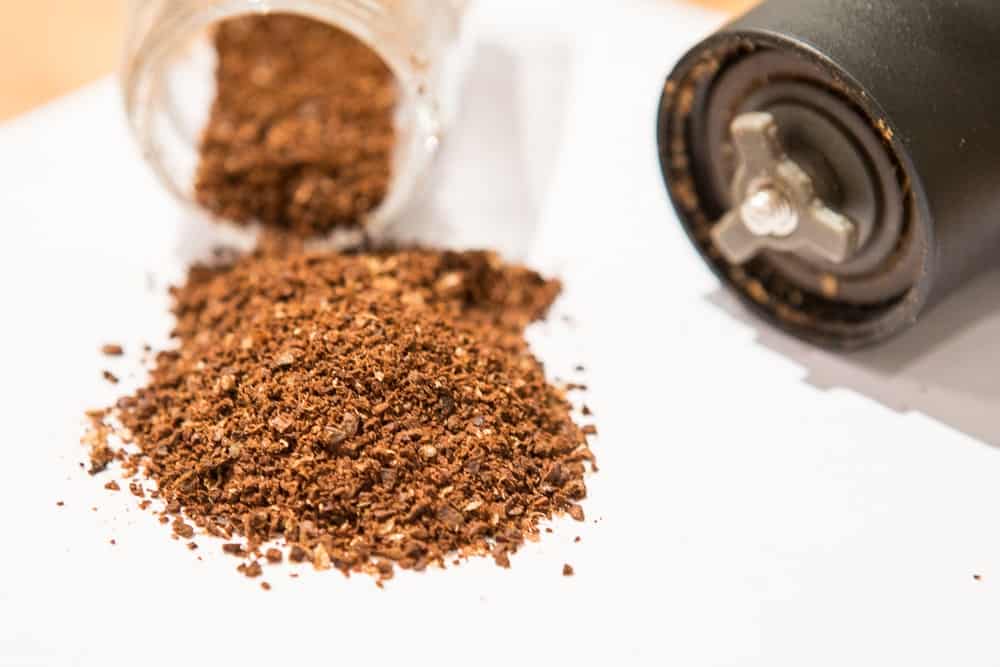
Don’t go too coarse, though. Very coarse coffee under-extracts and tastes sour and hollow. If that happens, step one notch finer. Our coffee grind chart shows the sizes side by side.
Water temperature
The Specialty Coffee Association recommends brewing between 90 and 96 °C (195–205 °F). For French press, aim for the hotter end, about 95 °C: the water cools as it sits in the press, and hot water extracts more sweetness. No thermometer? Boil the kettle, then wait about 30 seconds before pouring.
Use filtered water if your tap water tastes of chlorine or leaves heavy scale. Coffee is more than 98% water, and you’ll taste it.
How to make French press coffee, step by step
This is the classic 4-minute method, scaled for a 4-cup (500 ml) press: 33 g of coffee and 500 g of water (1:15). The photos are from one of my own brews.
1. Heat the water and grind the coffee
Bring the water to a boil. While it heats, grind 33 g of coffee coarse. Pour a little hot water into the press to warm it, swirl, then tip it out. A warm press keeps the brew hotter for the full four minutes.
2. Add the coffee
Tip the grounds into the press and give it a gentle shake to level the bed. Put the press on your scale and tare it to zero.
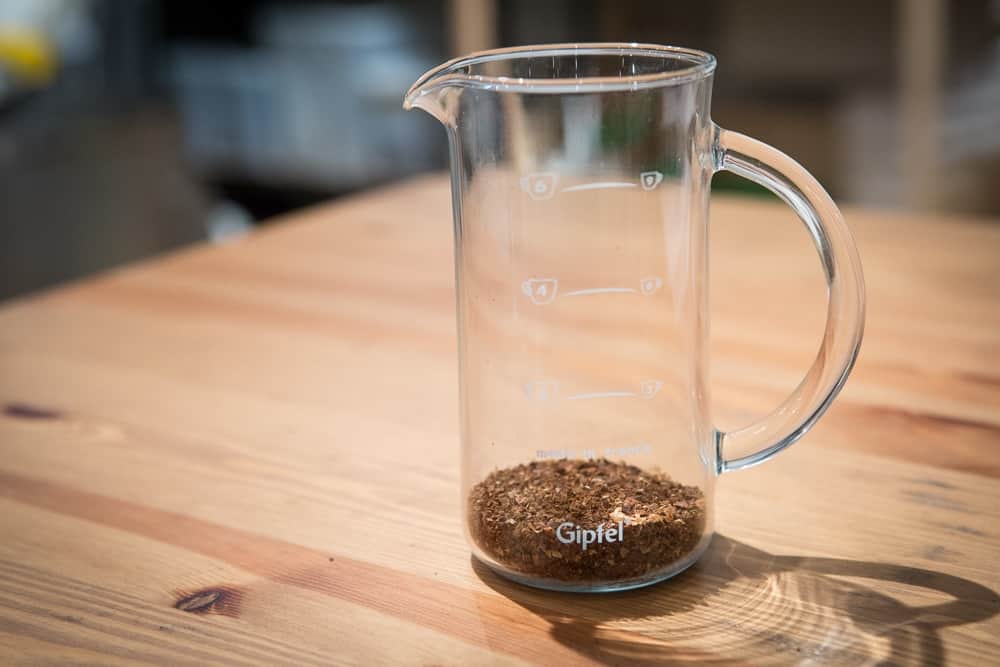
3. Bloom: wet the grounds and wait 30 seconds
Start a timer and pour about twice the coffee’s weight in water (around 70 g), making sure every ground gets wet. The coffee will bubble and swell — that’s carbon dioxide from roasting escaping. Letting it out first means the rest of the water can get to the coffee evenly. Very fresh coffee blooms a lot; stale coffee barely moves.
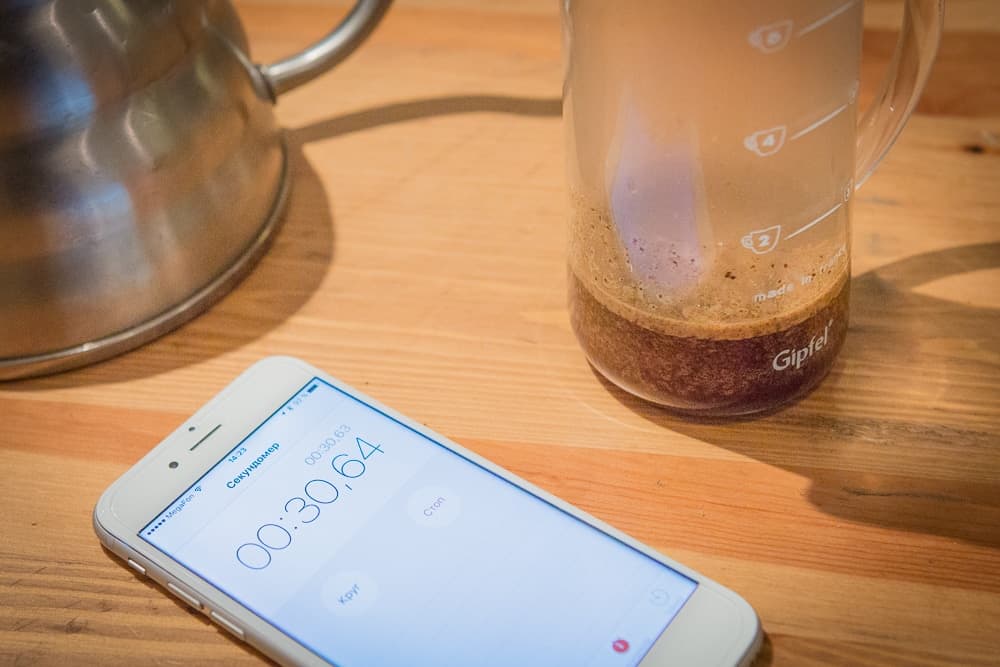
4. Pour the rest of the water
At 0:30, pour the rest of the water up to 500 g in a steady circle. Give it one gentle stir so no dry clumps are left, then put the lid on with the plunger pulled all the way up. The lid is just there to hold in the heat.
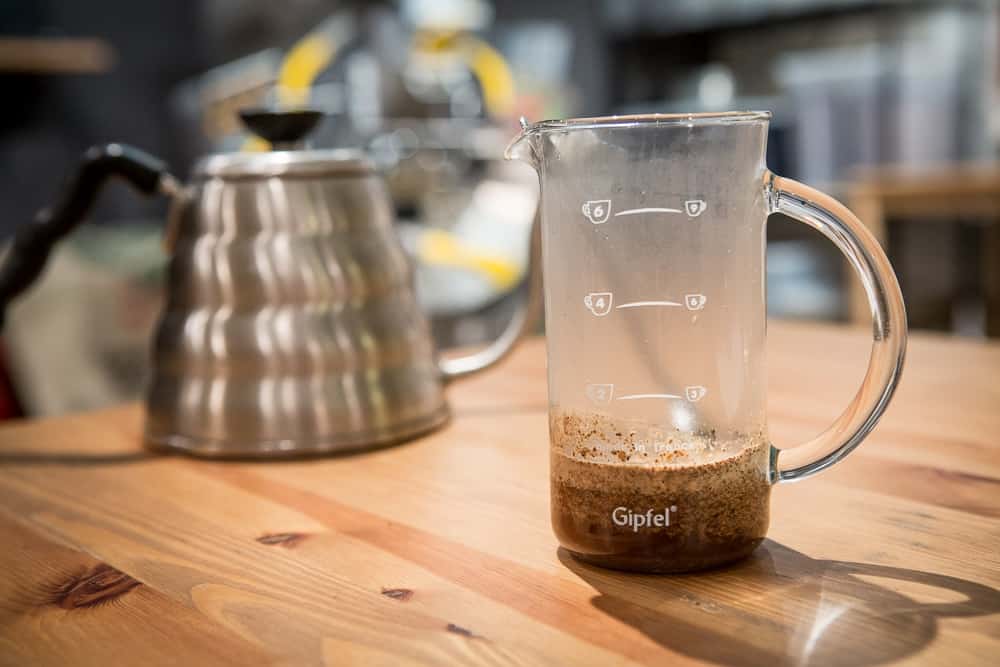
5. Steep until 4:00
Leave it alone. A crust of grounds forms on top, which is normal. Four minutes is the sweet spot for most coffees. Go to 5 minutes for a light roast, or 3½ for a very dark one.
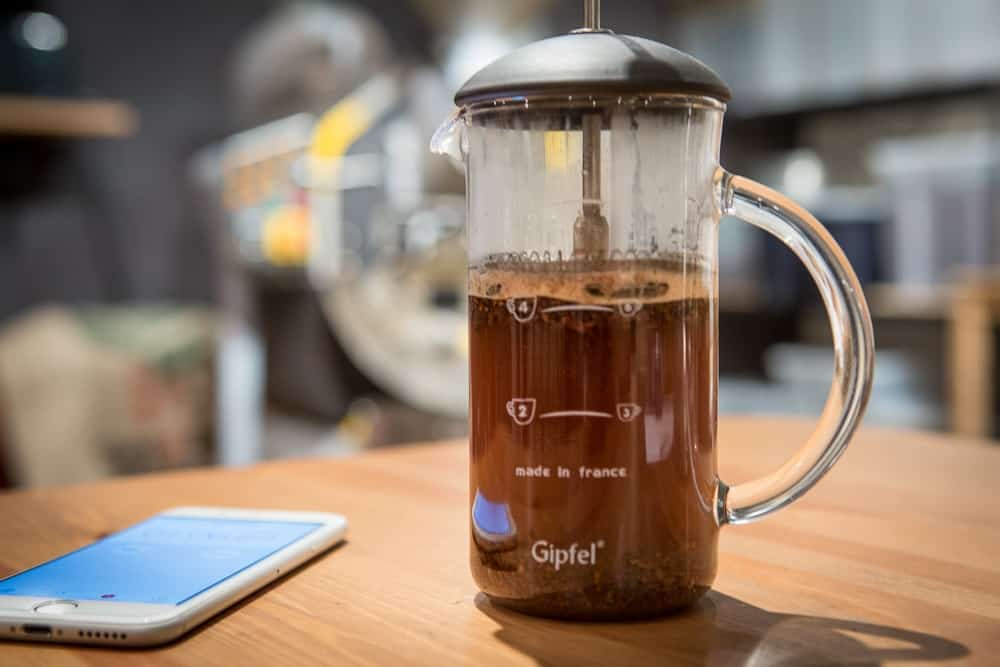
6. Press slowly and pour it all out
Press the plunger down slowly and evenly, taking about 15–20 seconds. If it fights back, your grind is too fine. Ease off rather than forcing it, or you’ll squirt hot coffee and push silt through the mesh. Then pour all the coffee out into cups or a thermos. Coffee left on the grounds keeps brewing and turns bitter within minutes.
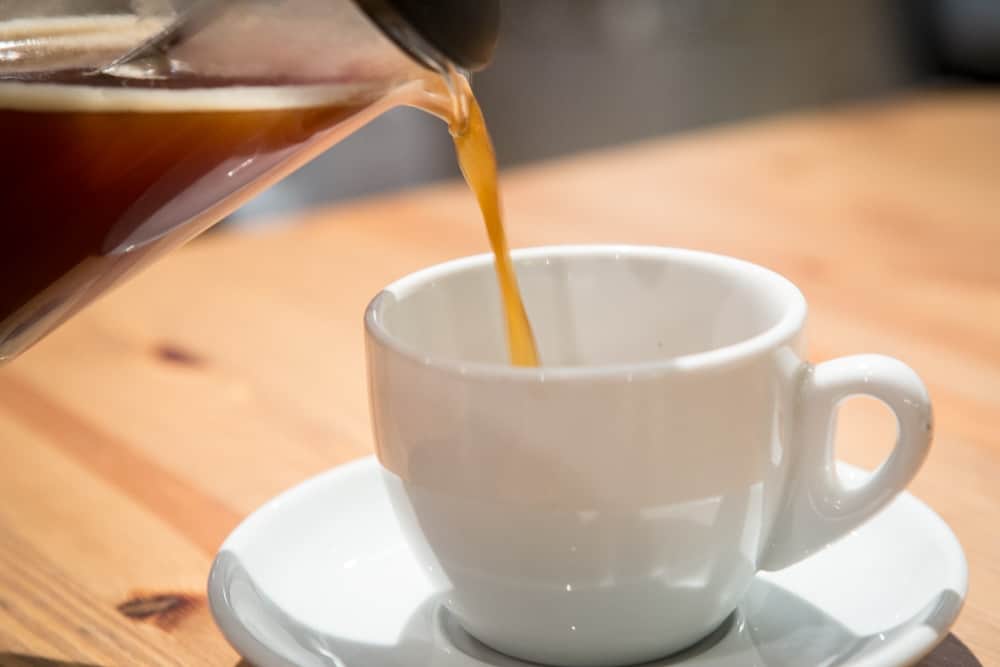
Pro tip: leave the last centimetre (½ inch) of coffee in the press. That’s where the silt collects, and it’s what makes the last sip gritty.
For a cleaner cup: the slow method
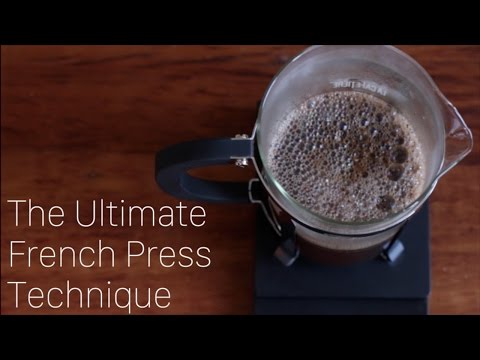
Mud at the bottom of the cup is French press’s one real flaw. James Hoffmann, World Barista Champion in 2007, popularised a fix that sounds wrong but works: brew longer and don’t press.
- Use 30 g of coffee to 500 g of water (1:16.7), ground medium-coarse, with water just off the boil.
- Pour all the water at once and leave it for 4 minutes.
- Stir the crust gently so it sinks, then scoop off the foam and floating bits with two spoons.
- Wait another 5 minutes or more. The fine particles sink to the bottom.
- Lower the plunger only to the surface of the coffee, not into the grounds, and pour slowly.
Why doesn’t 9 minutes make it bitter? In a full immersion brew, most of the extraction happens early, and it slows down sharply as the water cools and fills with dissolved coffee. The extra time mostly lets the silt settle. The result is a sweeter, cleaner cup that’s almost like pour-over, but with French press body. It’s the default recipe in our timer above. Choose Classic 4-minute there if you’re in a hurry.
Troubleshooting: fix your French press
Change one thing at a time, and start with the grind. It has the biggest effect.
| Your cup is… | Likely cause | Try this |
|---|---|---|
| Bitter, harsh, drying | Over-extracted: grind too fine, or coffee left on the grounds | Grind coarser. Pour everything out as soon as you press. |
| Sour, thin, salty | Under-extracted: grind too coarse, water too cool, or too short a brew | Grind a little finer. Use hotter water or steep 30–60 seconds longer. |
| Weak or watery | Not enough coffee | Move from 1:17 towards 1:15. Weigh rather than scoop. |
| Too strong | Too much coffee | Use a wider ratio, or add a splash of hot water to the cup. |
| Muddy or gritty | Fines from the grinder, or a hard plunge stirring them up | Try the slow method. Press gently. Leave the last sip in the pot. |
| Plunger hard to push | Grind too fine, clogging the mesh | Grind coarser. Lift the plunger slightly and press again, slowly. |
| Flat, no aroma | Stale coffee | Buy smaller bags of whole beans and grind right before brewing. |
What coffee works best in a French press?
French press is forgiving, but it shows off body and chocolatey, nutty flavours. That’s why medium and medium-dark roasts are the classic choice: think Brazil, Colombia, Guatemala or Sumatra. Light roasts work too, and can taste fantastic, but they need the hotter end of the temperature range and a minute more of steeping.
Whatever you choose, freshness matters more than origin. Look for a roast date on the bag, and drink it within about a month of that date. Buy whole beans if you can: ground coffee loses aroma within days.
Cold brew in a French press
Your press makes excellent cold brew, and the plunger does the filtering for you:
- Add 100 g of extra-coarse coffee to the press.
- Pour in 500 g of cold, filtered water (a 1:5 concentrate) and stir until every ground is wet.
- Put the lid on without pressing, and leave it in the fridge for 12–18 hours.
- Press slowly, then pour the concentrate into a jar. It keeps for about a week in the fridge.
- To serve, mix it 1:1 with water or milk over ice.
How to clean a French press
Don’t pour the grounds down the sink, because they clog drains. Add a little water, swirl, and tip the slurry into a sieve over the bin or onto your compost or garden. Rinse the press and plunger with hot water after every brew.
Once a week, unscrew the plunger and wash the mesh, cross plate and spring with warm soapy water. Coffee oils trapped between the layers go rancid and make every brew taste stale. If the mesh gets bent or torn, replace it; spare filters are cheap.
Is French press coffee bad for your cholesterol?
It’s a fair question. Coffee beans contain natural oils called diterpenes, mainly cafestol and kahweol, that can raise LDL (“bad”) cholesterol. A paper filter traps most of them, but the metal mesh of a French press doesn’t. That’s why unfiltered coffee has much more cafestol per cup than drip coffee.
How much does it matter? Harvard Health quotes Dr. Eric Rimm of the Harvard T.H. Chan School of Public Health: five to eight cups a day of unfiltered coffee may raise LDL cholesterol, and he suggests keeping pressed coffee to four cups a day or fewer. A large Norwegian study that followed more than 500,000 people for about 20 years found the lowest death rates among people who drank one to four cups of filtered coffee a day. If you have high cholesterol, enjoy French press as a treat, or pour it through a paper filter. Your doctor is the best person to ask. See our health disclaimer.
French press FAQ
Four minutes is the classic steep time for a medium grind and medium roast. Go up to 5 minutes for light roasts, or down to 3½ for very dark ones. With the slow method (steep 4 minutes, break the crust, then let it settle 5 more), a total of about 9 minutes still tastes clean, because the extra time mostly lets the fine particles sink.
Yes, once. Give it a gentle stir after you add the water (or break the crust at the 4-minute mark) so that no dry clumps are left. Stirring more than that, or stirring hard, only kicks up fines and makes the cup muddier.
You can, but most supermarket ground coffee is a medium drip grind, finer than French press likes. Expect more sediment and a harder plunge. Shorten the steep to about 3 minutes, press gently, and leave the last bit of coffee in the pot. Freshly ground coarse coffee will always taste better.
It tastes stronger because it has more body: oils and very fine particles pass through the metal mesh, where a paper filter would catch them. Caffeine and strength depend mostly on how much coffee you use. At the same ratio, French press and drip coffee are similar.
Fine particles (fines) pass through the mesh. Use a burr grinder at a coarse setting, press slowly, don’t pour the last centimetre, and try the slow method: let the grounds settle for 5 minutes after the steep and only lower the plunger to the surface.
Two Frenchmen, Mayer and Delforge, patented the first press-style coffee maker in 1852. The modern design, with a sealed mesh plunger, was patented by Italian designers Attilio Calimani and Giulio Moneta in 1929. The press became popular in France, which is how it got its name. In the UK it’s often called a cafetière.
Sources
- Specialty Coffee Association, Coffee Standards (brewing temperature and brew ratios).
- National Coffee Association, French press coffee (ratio range and grind).
- James Hoffmann, The Ultimate French Press Technique (the slow, no-press method).
- Harvard Health Publishing, Pressed coffee is going mainstream — but should you drink it? (2016).
- Tverdal A. et al., Coffee consumption and mortality from cardiovascular diseases and total mortality: Does the brewing method matter?, European Journal of Preventive Cardiology (2020).
- Barista Hustle, The History of French Press.
How we work: how we test · editorial policy · research & sources.
Published · Last updated