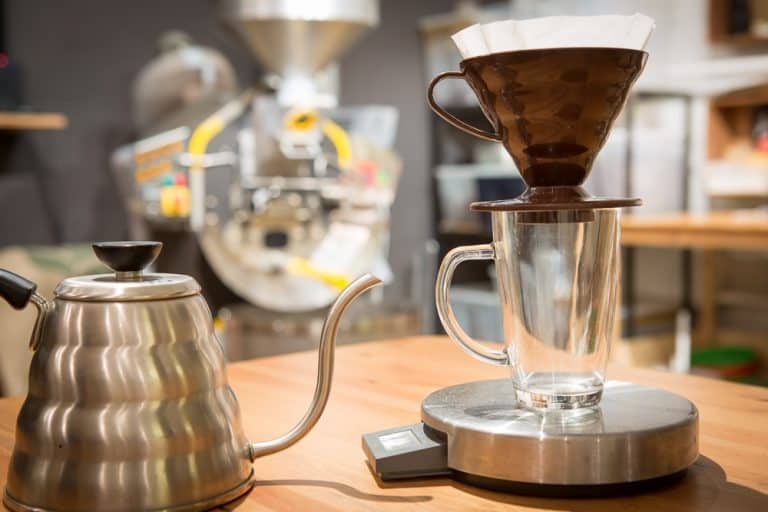
Coffee to Water Ratio: Calculator & Chart
How much coffee per cup in grams and tablespoons, the right ratio for pour over, drip, French press, cold brew and espresso, and how to fix weak, sour or bitter coffee.

Ratios and timings follow established specialty-coffee recipes, credited in the brew widget. How we test · Editorial policy
Coffee ratio cheat sheet
| Method | Ratio | Grind | Water | Time |
|---|---|---|---|---|
| French press | 1:16.7 | Medium-coarse | 95 °C | 9:30 |
| Pour over | 1:16.7 | Medium-fine | 95 °C | 3:30 |
| Chemex | 1:16.7 | Medium-coarse | 95 °C | 4:00 |
| Siphon | 1:14.7 | Medium-fine | 93 °C | 2:10 |
| Vietnamese phin | 1:5 | Medium-fine | 96 °C | 5:00 |
| Clever Dripper | 1:16.7 | Medium-fine | 96 °C | 3:30 |
| Drip coffee maker | 1:17 | Medium | 93 °C | — |
| AeroPress | 1:18 | Medium-fine | 95 °C | 3:25 |
| Moka pot | 1:10 | Fine | Just off the boil | — |
| Turkish coffee | 1:10 | Extra fine | Cold | — |
| Cold brew | 1:5 | Coarse | Cold | 12–18 h |
| Espresso | 1:2 | Fine | 93 °C | 0:28 |
Grams of water per gram of coffee, for each method's default recipe. Use the calculator for your exact amounts.
The coffee-to-water ratio is the single number that decides whether your coffee tastes strong or weak. For most brewing, start at 1:16, 1 gram of coffee for every 16 grams of water. That’s about 15 g of coffee for an 8 oz (240 ml) cup. From there, the right ratio depends on your brew method and your taste, and this guide shows you how to dial it in.
- Filter coffee (pour over, drip, French press): 1:15 to 1:17. 1:16 is a great start.
- Without a scale: 2 level tablespoons of ground coffee per 6 oz of water, or 3 per 8 oz mug.
- Concentrated brews: espresso 1:2, moka pot and Turkish coffee about 1:10, cold brew concentrate 1:5.
- Too strong or too weak? Change the ratio. Sour or bitter? Change the grind first.
The calculator at the top of this page does the maths for any brew method, number of cups and strength, in grams or ounces.
What “1:16” means, and how to use it
A brew ratio compares the weight of coffee to the weight of water you brew with. In 1:16, every 1 g of coffee gets 16 g of water. Because 1 ml of water weighs 1 g, you can measure the water on a scale or in a jug.
- Know your water, need the coffee? Divide: 500 g of water ÷ 16 = 31 g of coffee.
- Know your coffee, need the water? Multiply: 20 g of coffee × 16 = 320 g of water.
A smaller second number means a stronger cup: 1:15 is stronger than 1:17. One catch: the ratio counts the water you pour, not the coffee you drink. The grounds keep about twice their weight in water, so 500 g of water and 31 g of coffee give roughly 440 g in the cup.
How much coffee per cup
Here is how much ground coffee to use for common cup sizes at the three most popular ratios:
| Water | Stronger (1:15) | Balanced (1:16) | Lighter (1:17) |
|---|---|---|---|
| 6 oz (180 ml) | 12 g · 2½ tbsp | 11 g · 2 tbsp | 10.5 g · 2 tbsp |
| 8 oz (240 ml) | 16 g · 3 tbsp | 15 g · 3 tbsp | 14 g · 3 tbsp |
| 12 oz (350 ml) | 23 g · 4½ tbsp | 22 g · 4½ tbsp | 21 g · 4 tbsp |
| 16 oz (475 ml) | 32 g · 6½ tbsp | 30 g · 6 tbsp | 28 g · 5½ tbsp |
| 1 liter (34 oz) | 67 g · 13½ tbsp | 63 g · 12½ tbsp | 59 g · 12 tbsp |
About the “1 tablespoon per 4 oz” rule: with level spoons, that works out to about 1:24, which makes thin, weak coffee. The National Coffee Association’s guideline of 2 tablespoons per 6 oz is close to 1:18, which is a much better start. Also check what a “cup” means on your machine: coffee-maker cups are only 5–6 oz. Our coffee maker guide has a table for 4 to 12 cups.
Coffee-to-water ratio by brew method
The cheat sheet at the top of the page lists the numbers for each method. Here’s why they differ. Methods where water flows through the coffee (percolation) extract a little more efficiently than methods where coffee sits in the water (immersion). And some methods are meant to make a small, concentrated drink.
Pour over: 1:15 to 1:17
Start at 1:16.7 (15 g to 250 g) for one cup. Go towards 1:15 for a richer cup, or 1:17 for a lighter, more tea-like one. Our pour over guide has the full method and a timer. Using a Chemex? Its thick filter drains slowly, so grind coarser and stay around 1:16; see our Chemex guide.
Drip coffee maker: 1:16 to 1:18
The SCA’s “golden cup” is 55 g of coffee per liter of water, about 1:18. Most people like it a little stronger, at 1:16–1:17. See our guide to using a coffee maker.
French press: 1:15 to 1:17
Immersion brews are traditionally a bit stronger, at 1:15, for that heavy, bold cup. A longer, gentler brew at 1:16.7 tastes sweeter and cleaner. Both are in our French press guide.
AeroPress: 1:12 to 1:18
The most flexible brewer there is. Our everyday recipe is 11 g to 200 g (1:18). The official AeroPress recipe is stronger, at about 1:13, and a 1:5 concentrate makes a good base for milk drinks. All three are in our AeroPress guide.
Cold brew: 1:5 concentrate, 1:8 ready to drink
Cold water extracts slowly, so cold brew needs a lot more coffee. Make a 1:5 concentrate and dilute it 1:1 with water or milk over ice, or brew at 1:8 to drink straight. Steep it in the fridge for 12–18 hours. More in our cold brew guide.
Espresso: 1:2
Espresso ratios count the drink that comes out, not the water going in. A classic double is 18 g of coffee to 36 g of espresso in 25–30 seconds. Go to 1:1.5 for a thicker, more intense ristretto, or 1:2.5–1:3 for a lighter, longer shot that suits light roasts. Our espresso guide shows how to dial it in.
Moka pot and Turkish coffee: about 1:10
Both make small, strong cups. A moka pot’s size sets its ratio: fill the basket level and the water to just below the valve. A 3-cup pot is about 15 g of coffee to 150 ml of water (see our moka pot guide). Turkish coffee uses about 7 g of very finely ground coffee per 70 ml cup (see our Turkish coffee guide).
Strength vs extraction: why ratio isn’t everything
Two different things decide how your coffee tastes, and mixing them up is the most common brewing mistake:
- Strength is how concentrated the drink is: thin and watery, or heavy and intense. It’s set mostly by the ratio. Coffee professionals measure it as TDS (total dissolved solids); good filter coffee is about 1.15–1.35%.
- Extraction is how much flavour you pulled out of the grounds. Too little tastes sour and hollow; too much tastes bitter and drying. It’s set mostly by grind size, time and temperature. The sweet spot is 18–22% of the coffee’s weight dissolved into the cup.
Those ranges come from the SCA’s “golden cup” standard, which is built on the Coffee Brewing Control Chart from the 1950s (with a refractometer, you can plot your own brew in our extraction calculator). So before you change the ratio, work out what is actually wrong:
| Your cup tastes… | What’s wrong | Change this |
|---|---|---|
| Weak and sour | Under-extracted | Grind finer (not more coffee) |
| Weak and bitter | Too little coffee, over-extracted | Use more coffee and grind coarser |
| Strong and bitter | Over-extracted | Grind coarser or brew shorter |
| Strong and sour | Too much coffee, under-extracted | Use a bit less coffee and grind finer |
| Sweet but too intense | Well extracted, just strong | Use more water: move from 1:15 towards 1:17 |
| Sweet but thin | Well extracted, just weak | Use more coffee: move from 1:17 towards 1:15 |
And there’s no single “correct” strength. A 2023 study from the UC Davis Coffee Center mapped what everyday coffee drinkers actually like and found two distinct groups. One preferred lighter, lower-strength coffee, the other stronger cups. The SCA’s own research summary puts it plainly: there is no “one size fits all”. So treat 1:16 as a starting point, then trust your own taste.
How to measure coffee and water
Use a kitchen scale that reads to 1 g, or better, 0.1 g. It’s the cheapest upgrade in coffee. Put your brewer on the scale, tare it, add the coffee, tare again, and pour the water until the scale reads your target.
Scoops and spoons are less exact than they look:
- Roast changes the weight. Dark-roast beans are bigger and lighter than light-roast beans, so a scoop of dark roast holds less coffee.
- Grind changes the weight. Fine coffee packs denser in a spoon than coarse coffee.
- “Level” vs “heaped” can double it. A heaped tablespoon can hold 8–10 g instead of 5 g.
If you do use spoons, weigh a level spoonful of your coffee once, and use that number from then on.
When to change your ratio
- Adding milk? Brew stronger, at about 1:13–1:15, so the coffee doesn’t disappear.
- Light roast? It’s harder to extract. Grind a little finer first, and only then make the ratio stronger if it still tastes thin.
- Dark roast? It extracts easily and can taste harsh at strong ratios. Try 1:17.
- Iced coffee? Count the ice as part of the water: brew with less hot water directly onto ice and keep the overall ratio the same.
- Bigger batch? Keep the ratio, but grind slightly coarser. More coffee in the filter means a deeper bed that drains more slowly.
Change one thing at a time, and write down what you did. Two or three brews are usually enough to find your ratio. Our coffee grind chart helps with the grind side.
Coffee ratio FAQ
The Specialty Coffee Association’s “golden cup” standard is 55 g of coffee per liter of water, about 1:18. In practice most people brew filter coffee a little stronger, at 1:15–1:17, and 1:16 is the most common starting point.
Use about 3 level tablespoons of ground coffee (15 g) for an 8 oz (240 ml) mug, or 2 level tablespoons for a 6 oz cup. A level tablespoon of ground coffee weighs about 5 g; a standard coffee scoop is 2 tablespoons.
About 15 g of coffee for an 8 oz (240 ml) cup at 1:16. Use 16 g for a stronger cup (1:15) or 14 g for a lighter one (1:17). For a 12 oz mug, use 21–23 g.
A 12-cup coffee maker holds about 60 oz (1.8 liters), because machine “cups” are only 5–6 oz each. At 1:17 that’s about 106 g of coffee: roughly 21 level tablespoons, or 10–11 scoops.
Yes, roughly. Caffeine dissolves easily, so most of it ends up in the cup whatever the method. More coffee per cup means more caffeine. A cup brewed at 1:15 has about 13% more caffeine than the same cup at 1:17. Dark roasts don’t contain more caffeine. They just taste stronger.
By weight. Volume depends on the roast and the grind: a scoop of dark roast or coarse coffee holds less coffee than a scoop of light roast or fine coffee. A cheap kitchen scale makes your coffee the same every day. For water, grams and milliliters are the same, so either works.
Espresso ratios measure the drink that comes out (for example, 18 g of coffee to 36 g of espresso), not the water that goes in. Espresso is also meant to be a small, concentrated drink, about 7–12% dissolved solids compared with roughly 1.3% in filter coffee.
Sources
- Specialty Coffee Association, Coffee Standards (golden cup: 55 g/L, 1.15–1.35% TDS, 18–22% extraction).
- Guinard J.-X. et al., A new Coffee Brewing Control Chart relating sensory properties and consumer liking to brew strength, extraction yield, and brew ratio, Journal of Food Science (2023).
- Specialty Coffee Association, How Hot is Hot Enough? (summary of the UC Davis brewing research).
- National Coffee Association, Drip coffee (the 2 tablespoons per 6 oz guideline).
- Counter Culture Coffee, Coffee Basics: Brewing Ratios (immersion vs percolation).
How we work: how we test · editorial policy · research & sources.
Published · Last updated