Coffee filter substitutes: what to use when you run out
Out of coffee filters? Swap in another brewer's filter, or use a paper towel, a sieve or clean cloth. How to brew with each, and what to skip.

Written from hands-on coffee experience and checked against our editorial standards. Editorial policy · Research sources
The easiest coffee filter substitute is another paper filter: most brewers will take one meant for a different brewer, cut or folded to fit. No spare filters at all? A sturdy paper towel, folded into several layers, will do once in a pour over dripper. No dripper? Steep the coffee in a jug for 4 minutes, then pour it through a fine sieve or tea strainer. Clean cotton cloth and reusable metal filters work too. Each one changes how clean the cup is, how fast it drains and how much of the coffee’s oil ends up in your mug.
Updated October 2026: rewritten with amounts for each substitute, a table of filters by brewer, safety notes and sources. The earlier version mixed filters with brewing methods, so brewing without a filter now has its own section.
- You have filters for another brewer: use them. V60 and Melitta filters swap both ways, and a Chemex filter fits a V60 folded down at the top. Denser paper drains slower, so grind a step coarser. An AeroPress takes a circle about 64 mm (2.5 in) across, cut from any paper filter.
- No filters, but a pour over dripper: a sturdy paper towel, folded into several layers, works in a pinch. It isn’t made for hot drinks, so use it once, not as a habit.
- No dripper: steep 30 g of coarse coffee in 500 g of hot water for 4 minutes, then pour it through a fine sieve or tea strainer.
- No filter of any kind: make cowboy coffee. Steep, let the grounds settle for 5 minutes, pour slowly.
- Skip: scented or printed paper, and cloth that still smells of detergent.
I brew with a lot of different gadgets, so I usually have filters in several sizes at home. When one size suddenly runs out, or a delivery doesn’t arrive in time, I swap in filters from another brewer and wait for the package. Brewing with no filter at all is my last resort. Every other substitute here has its place, though: use whatever is easiest in your kitchen.
Which coffee filter substitute to use
Start with what’s in your kitchen. Each option below has its own section with the steps and amounts.
| What you have | Use this | What the cup is like |
|---|---|---|
| Filters for another brewer | Cut or fold one to fit | Close to normal |
| A pour over dripper | Paper towel, in a pinch | Fairly clean, if the towel holds. It can tear. |
| A jug and a fine sieve or tea strainer | Steep, then strain | Heavier, with some sediment, like French press |
| Clean cotton cloth or cheesecloth | Cloth filter | Depends on the weave: tight drains slowly, loose lets sediment through |
| A reusable metal filter | Metal filter | Fuller body, a little sediment |
| Just a pot | Cowboy coffee | Heavy, with grounds at the bottom |
Use filters from another brewer
Most brewers will take another paper filter with a little cutting or folding, so check the cupboard before you reach for the paper towels. Here’s what fits.
| Brewer | Its own filter | Use instead | Watch for |
|---|---|---|---|
| AeroPress (Original, Clear, Go) | Paper disc, 64 mm (2.5 in) | A circle cut from a regular paper filter | It must lie flat, or the cap leaks |
| AeroPress XL | Paper disc, 74 mm (2.9 in) | A larger cut circle | Same |
| Chemex | Bonded paper, 20–30% heavier than other brands | A regular cone filter, in a pinch | Fits badly and drains faster, so the cup is thinner |
| Clever Dripper | Standard cone filter, size 4 (size 2 for the small one) | Any size 4 cone filter | Nothing: these are sold in most supermarkets |
| Hario V60 | Pointed cone filter | A Melitta-style filter with a flat bottom edge, or a Chemex filter folded down at the top | Denser paper drains slower: grind a step coarser, one or two for Chemex paper |
| Melitta-style dripper | Flat-bottom cone filter, #2 or #4 | A V60 filter | Thinner paper drains faster: if the cup is sour, grind a step finer |
| Drip coffee maker | #2 or #4 cone, or a flat-bottom basket | A reusable metal filter. A paper towel only for a small batch you watch | You can’t see the flow: a slow or torn towel overflows the basket |
| Moka pot, phin, French press | Built-in metal filter | Nothing to replace | None |
Swapping V60, Melitta and Chemex filters
The swap I make most often is between V60 filters, which come to a point, and Melitta-style filters, which have a flat bottom edge. They work in each other’s drippers, and it’s the simplest swap there is. In my experience, the flat-bottom Melitta filters are denser, so the water runs through more slowly.
Slower draining means the water stays on the coffee longer and pulls out more, until the cup turns bitter and drying. That’s called over-extraction. So when you put a Melitta filter in a V60, grind a step coarser. One mug in a V60 should finish at about 3:00–3:30; still dripping after 4:00 means go coarser again. Our pour over guide explains how to read the brew time.
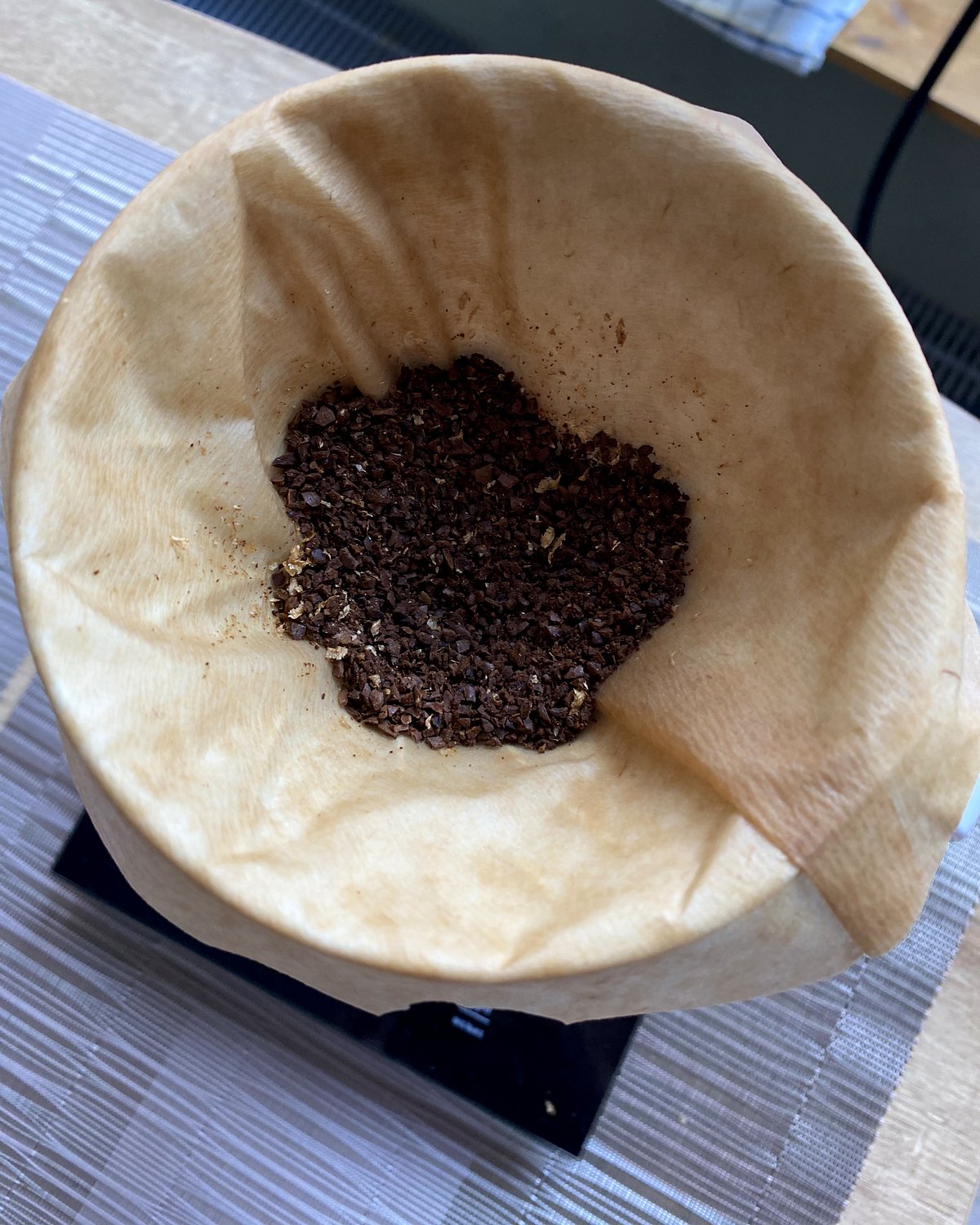
Going the other way, a thinner V60 filter in a Melitta dripper drains faster. If the cup tastes sour or thin, grind a step finer.
When I run out of V60 filters, I also use Chemex filters. They’re bigger, so I just fold the extra paper down over the top of the dripper. It doesn’t look pretty, but it solves the problem. The photo below is mine, from a brew by a lake.
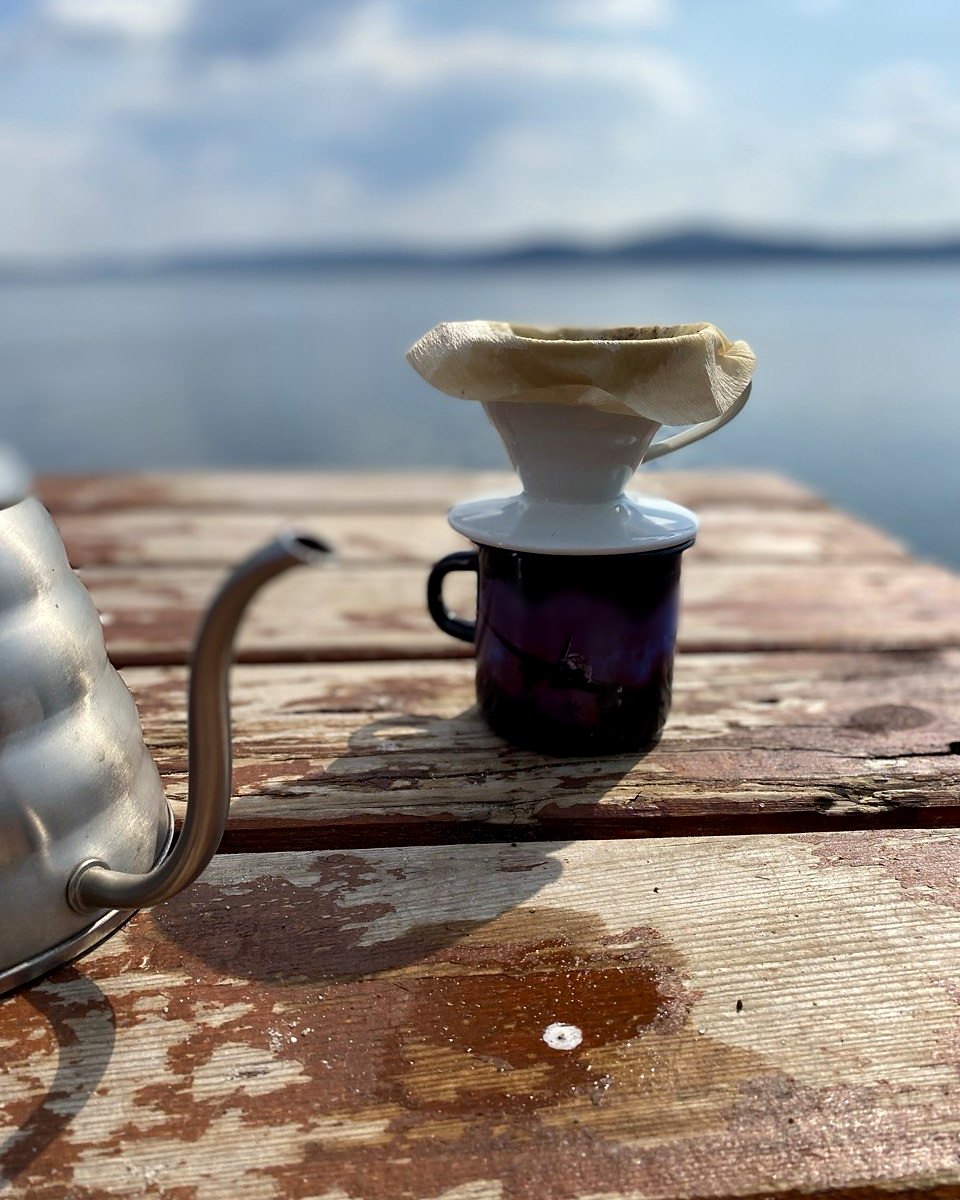
Chemex says its bonded filters are 20–30% heavier than other brands, so they drain more slowly still. Grind one or two steps coarser, as you would for a Chemex.
How to cut AeroPress filters from regular coffee filters
AeroPress makes its standard paper filters 64 mm (2.5 in) across, for the Original, Clear and Go. The Coffee Chronicler notes that you can cut them from regular cone filters with a bit of patience.
- Use a flat-bottom basket filter if you have one: the flat base gives a full circle with no seam. From a cone filter, cut from one flat side, away from the crimped seam. Thin papers, like V60 filters, work better doubled.
- Trace around the AeroPress filter cap and cut just inside the line.
- Lay the circle in the cap. It should sit flat over the holes with no folds, because a fold lets coffee and grounds leak around the edge.
- Brew as usual: 11 g of coffee, 200 g of water at 95 °C (203 °F), steep 2 minutes, press gently.
Christensen also reports that a 6 cm moka pot paper filter worked in his AeroPress, though it’s slightly too small and needs careful placing.
Before you cut anything, look at the last filter you used. As our AeroPress guide explains, a paper filter can be rinsed and used several times, until it tears or tastes stale.
I don’t need to do this often. When I do cut AeroPress circles from V60 filters, I use two layers, because a single layer of V60 paper is too thin.
No spare filters: how to use each substitute
Paper towel: a one-off fix
A paper towel can stand in for a filter once, when there’s nothing else. It isn’t made for this: paper towels are designed to soak up spills, not to have hot coffee poured through them. Tasting Table notes that they can carry traces of glue and bleach from manufacturing. Arne Preuss of Coffeeness adds that only the strong kind works, because thin towels fall apart when wet.
Use a sturdy towel with no scent, print or lotion. That keeps out flavors you’d taste in the cup, but it doesn’t turn a paper towel into a coffee filter. Neither does the color: a brown towel isn’t proven to be any better for this than a white one.
- Fold one sheet in half, then in half again, into a square of four layers.
- Open one pocket into a cone, with three layers on one side and one on the other, and set it in your dripper.
- Pour hot water through it to rinse out the papery taste and warm the dripper. Pour gently: a wet towel tears more easily than a filter.
- Brew your usual recipe. For one mug, that’s 15 g of medium-fine coffee and 250 g of water at 93–96 °C (200–205 °F).
A pour over through a regular filter takes 3–3½ minutes for one mug. If the towel drains much more slowly, grind a step coarser next time. Our pour over guide has the full recipe.
I’ve tried it. It works, but the towel falls apart quickly, so you need several layers, and it isn’t a method I like.
An automatic drip coffee maker is a riskier place for a paper towel. The machine pours on its own schedule and you can’t see the basket: if the towel slows the flow, folds over or tears, water and grounds can overflow. Your Dream Coffee advises against it for that reason. If it’s your only option, brew a small batch and stay by the machine. A reusable metal filter, if your coffee maker has one, is the better fix.
Sieve or tea strainer: steep, then strain
With no dripper, brew the coffee like a French press in any heatproof jug, then strain it. Asser Christensen, the Q grader behind The Coffee Chronicler, prefers a tea strainer to other stand-ins because it’s made for hot water.
- Grind 30 g of coffee coarse, like sea salt. Fine grounds slip through the mesh.
- Pour in 500 g of water about 30 seconds off the boil, around 95 °C (203 °F), and stir.
- Steep for 4 minutes.
- Pour slowly through a fine sieve or tea strainer into your mugs. Leave the last centimeter (½ in) in the jug: that’s where the sludge is.
I’ve used a sieve too, and it does the job, especially a very fine one. Some sediment always stays in the cup, so grind coarse.
Some fine grounds will get through, as they do in a French press. For a cleaner cup, line the sieve with a paper towel. For other amounts, our coffee-to-water ratio calculator does the math.
Cloth napkin, dish towel or cheesecloth
Clean cotton cloth can work as a makeshift coffee filter, though the weave makes a big difference. Tightly woven fabric may drain slowly, while loose cheesecloth lets more sediment through. Fold cheesecloth into several layers if needed.
Choose cloth suitable for contact with food, with no detergent or fabric-softener smell, and rinse it thoroughly with hot water before brewing. Coffee can leave lasting stains, so skip your favorite napkins.
The easiest approach is to steep the coffee first, then pour it through a cloth-lined sieve into a heatproof jug. This gives you more control than putting unfamiliar fabric in an automatic drip coffee maker.
When I tried cloth, the coffee drained very slowly, and I had to adjust the grind. The cleanup also made it less convenient for me. I’m more likely to use it for straining a batch of cold brew than for my everyday cup.
A coffee stain doesn’t automatically mean the cloth needs to be thrown away. Whether you can reuse it depends on the material and its care instructions. For regular brewing, a purpose-made reusable coffee filter is a more practical choice.
Cloth filters made for coffee
A coffee sock is a reusable cloth filter designed for brewing, not a sock from your drawer. Unlike an improvised kitchen cloth, it has a shape and weave intended for coffee.
Care instructions vary by product. For its flannel filters, such as the one in its Woodneck drip pot, Hario recommends rinsing thoroughly after brewing and storing the filter submerged in clean water in the refrigerator, rather than letting it dry out. Follow the instructions for your particular filter; don’t assume every cloth filter needs the same care.
I’ve dried my Hario filter between occasional uses without noticing an off taste, but that differs from Hario’s recommended routine. It’s a personal observation, not the storage method I recommend readers follow.
I like the idea of reusable cloth filters, but the extra cleaning and storage are why I rarely reach for mine.
Reusable metal filter
If you have a gold-tone or stainless filter for your coffee maker or dripper, use it with your usual recipe. Metal lets the coffee oils and some fine particles through, so the cup is heavier, closer to French press. It also lets through more cafestol, which matters if you drink a lot of it (see below).
Paper tea filter bags
Paper tea filter bags work for one mug. Fill one with 15 g (3 level tablespoons) of medium-coarse coffee, hang it in 250 g of hot water, steep for 4 minutes, then lift it out.
I’ve used them too, and they work: a tea bag of coffee does the job of a drip bag, the single-serve filter pouch that hangs on the rim of a mug.
How to make coffee without a filter
Some coffee needs no filter at all. The cup is heavier, with grounds settled at the bottom, so pour slowly and leave the last sip.
Cowboy coffee
This is the French press recipe made in a saucepan. The long settle comes from the slow French press method James Hoffmann popularized, explained in our French press guide.
- Bring 500 g of water to a boil, take it off the heat and wait about 30 seconds.
- Stir in 30 g of coarse coffee, like sea salt.
- Steep for 4 minutes.
- Leave it alone for 5 more minutes so the grounds sink.
- Pour slowly into your mugs and leave the last centimeter (½ in) in the pot.
On a camping trip, this is what I do, or I brew straight in the mug. I grind coarse, and once the grounds have settled, I carefully skim what’s still floating off the top with a spoon. That’s how we clear the cups at a cupping, the standard way coffee professionals taste coffees side by side.

Turkish coffee
For each cup, heat 7 g of powder-fine coffee and 70 ml of cold water slowly in a small pot called a cezve until a thick foam rises. The grounds stay in the cup and settle while you wait. Our Turkish coffee guide has the full method.
Coffee brewed in the mug
Stir ground coffee straight into hot water, wait for it to sink, and drink from the top. Arne Preuss of Coffeeness suggests a slightly coarser grind and a lower dose than for filter coffee, stirred right after the water goes in. He tried it with espresso-fine coffee and called it a complete flop.
If you have a French press or moka pot
Both have a metal filter built in, so running out of paper doesn’t matter. See our French press guide and moka pot guide. Instant coffee needs no filter either: it dissolves.
What to skip
- Scented, printed or lotion paper towels. You’ll taste them.
- Thin paper towels and tissues. They fall apart when wet.
- Cloth washed with detergent or fabric softener and not rinsed well. Fabric holds on to it.
- Socks you wear, however clean.
Unfiltered coffee and cholesterol
A filter changes more than the sediment in your cup. Coffee contains oily compounds called diterpenes, including cafestol, that can raise LDL (“bad”) cholesterol. Paper coffee filters retain much of these compounds, while metal filters and sieves allow more of them into the drink.
That matters when choosing your everyday brewing method. French press, Turkish coffee and cowboy coffee generally contain more diterpenes than paper-filtered coffee. Harvard Health discusses this difference in its guidance on unfiltered coffee.
There isn’t a single number of cups that works as a safe limit for everyone. Serving sizes, brewing methods and individual health circumstances differ. If you have high cholesterol, ask your healthcare professional whether paper-filtered coffee would be a better everyday choice for you. Read our health disclaimer.
So you don’t run out again
- A reusable metal filter for your coffee maker or dripper. Fuller body, a little sediment, and more cafestol than paper.
- A stainless steel AeroPress filter. AeroPress sells one. It gives a heavier, French-press-style cup.
- A cloth filter or coffee sock. Follow the care instructions for your particular filter.
- A spare pack of #4 cone filters. Coffeeness notes that #4 fits most coffee makers, and you can cut them down for an AeroPress.
Coffee filter substitute FAQ
In a pinch, once, in a pour over dripper. Use a sturdy towel with no scent, print or lotion, folded into several layers. Paper towels aren’t made for filtering hot drinks and tear easily, so pour gently. In an automatic drip coffee maker it’s riskier: you can’t watch the flow, and a slow or torn towel can overflow the basket.
Another paper filter, cut or folded to fit your brewer. With no filters at all, a sturdy paper towel in a pour over dripper works in a pinch. Without a dripper, steep 30 g of coarse coffee in 500 g of hot water for 4 minutes and pour it through a fine sieve or tea strainer.
Yes. Cowboy coffee, Turkish coffee, French press and moka pot all work without a paper filter. For cowboy coffee, steep coarse coffee in hot water for 4 minutes, let the grounds settle for 5 minutes, then pour slowly.
A coffee sock, made for brewing, yes. A sock you wear, no: even a clean one holds detergent, and you’ll taste it. Use clean cotton cloth or cheesecloth instead.
Yes. A Chemex filter is bigger, so fold the extra paper down over the top of the dripper. Chemex paper is 20–30% heavier than other brands, so it drains more slowly: grind one or two steps coarser than your usual V60 grind.
Yes, and V60 filters work in a Melitta-style dripper too. Melitta filters have a flat bottom edge and denser paper, so in a V60 they drain more slowly: grind a step coarser. One mug should finish in about 3:00–3:30. A thinner V60 filter in a Melitta dripper drains faster, so grind a step finer if the cup tastes sour.
Yes. Trace the AeroPress filter cap on a flat-bottom basket filter and cut just inside the line, for a circle about 64 mm (2.5 in) across. It must lie flat in the cap, or the brew leaks around the edge. V60 paper is thin, so cut two circles and use them together.
Unfiltered coffee contains more diterpenes, including cafestol, which can raise LDL cholesterol. Paper coffee filters retain much of these compounds; metal filters and sieves do not remove them as effectively. If you have high cholesterol or drink unfiltered coffee regularly, discuss your brewing method and intake with your healthcare professional.
Sources
- AeroPress, Paper Micro-Filters (standard size, 2.5 in) and XL Paper Micro-Filters (2.9 in).
- Asser Christensen, The Coffee Chronicler, How to Find the Best Paper Coffee Filters (tea strainer as a substitute).
- The Coffee Chronicler, AeroPress Filters: Metal vs Paper vs Prismo (cutting AeroPress filters, moka pot filters).
- Arne Preuss, Coffeeness, How to Brew Coffee (paper towels, cloth and detergent, brewing in the cup).
- Coffeeness, How to Buy the Best Coffee Filter (#4 filter size).
- Ryan Cashman, Tasting Table, The Paper Alternative For When You’re Out Of Coffee Filters (2023).
- Your Dream Coffee, The Best Coffee Filter Substitutes (paper towels in a drip coffee maker).
- Hario, FAQ (in Japanese; storing flannel filters).
- Chemex, Bonded filters (20–30% heavier than other brands).
- Specialty Coffee Association, Coffee Standards (brewing temperature).
- Harvard Health Publishing, Pressed coffee is going mainstream, but should you drink it? (2016).
How we work: how we test · editorial policy · research & sources.
Published · Last updated