How to Use a Chemex
Brew clean, bright Chemex coffee: the ratio for every size (30 g to 500 g for two mugs), medium-coarse grind, the filter trick that stops a stalled brew, and a step-by-step brew timer.

Ratios and timings follow established specialty-coffee recipes, credited in the brew widget. How we test · Editorial policy
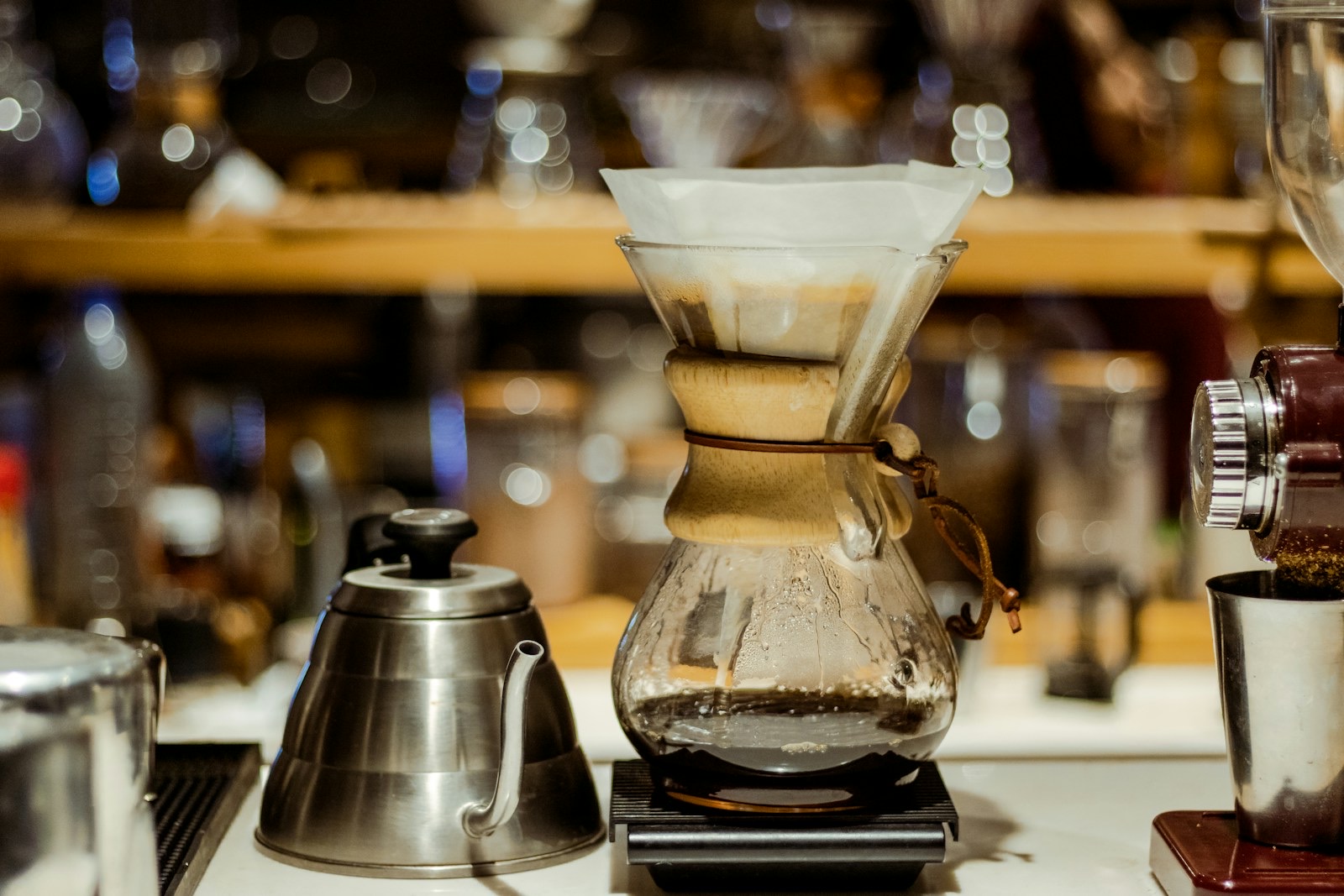
The Chemex is a pour over brewer and a carafe in one: an hourglass of glass with a wooden collar, and a paper filter 20–30% heavier than other brands. That thick paper is the whole point. It holds back almost all the oils and fine particles, so Chemex coffee is the cleanest, clearest cup you can brew at home. It’s also a little slower and fussier than a V60, and that’s what this guide is about.
- Ratio: 1:16 to 1:17. 30 g of coffee to 500 g of water makes two mugs.
- Grind: medium-coarse, like kosher salt. That’s coarser than for a V60.
- Water: 94–96 °C (200–205 °F), about 30 seconds off the boil.
- Filter: three-layer side against the spout, rinsed with hot water.
- Method: bloom with twice the coffee’s weight in water, then pour the rest in two stages.
- Time: done in about 4–4½ minutes. Faster and sour? Grind finer. Slower and bitter? Grind coarser.
The brew timer at the top of this page does the maths and the timing for you. Pick how many cups you want, press Start brewing, and it tells you when to pour and what your scale should read.
What you need
- A Chemex and Chemex bonded filters. The 6-cup Classic is the most common size. Use the real filters: they are what makes the cup taste like a Chemex (more on that below).
- A burr grinder. The thick filter clogs easily, and blade grinders make the fine dust that clogs it. See our coffee grinder guide.
- A kitchen scale with a timer, or a scale and your phone.
- A kettle. A gooseneck makes slow, steady pouring much easier, but a regular kettle works if you pour in short bursts.
- Fresh whole-bean coffee, ideally roasted within the last month.
Chemex ratio: how much coffee for each size
Use 1 gram of coffee for every 16–17 grams of water. Because the paper is so clean, Chemex coffee can taste a little light at the same ratio as other brewers, so don’t be afraid to go up to 1:15 if you like more body.
One thing confuses everyone: a Chemex “cup” is 5 oz (about 150 ml), not a mug. A 6-cup Chemex holds 30 oz, which is about three mugs of coffee.
| Brew size | Coffee | Water |
|---|---|---|
| 1 mug (3-cup Chemex) | 20 g · 4 tbsp | 330 g (11 oz) |
| 2 mugs (3- or 6-cup) | 30 g · 6 tbsp | 500 g (17 oz) |
| Full 6-cup Chemex | 42 g · 8½ tbsp | 700 g (24 oz) |
| Full 8-cup Chemex | 55 g · 11 tbsp | 900 g (30 oz) |
For other amounts, use our coffee-to-water ratio calculator.
Grind size for Chemex
Start at medium-coarse, about the texture of kosher salt or coarse sand. That’s one or two steps coarser than you’d use for a V60. Chemex says its bonded filters are 20–30% heavier than other brands, so water runs through them more slowly. With a V60 grind, a Chemex can take six or seven minutes and taste bitter and dry.
Like with any pour over, your brew time tells you whether the grind is right. For 30 g of coffee and 500 g of water, aim to finish at about 4:00–4:30:
- Done before 3:30 and the cup tastes sour or thin? Grind finer.
- Still dripping after 5:00 and the cup is bitter or dry? Grind coarser.
Bigger brews take longer: a full 6-cup Chemex (42 g to 700 g) can run to 5 minutes and still taste great. Our coffee grind chart shows the sizes side by side.
Water temperature
The Specialty Coffee Association recommends 90–96 °C (195–205 °F). Use the hot end for a Chemex. The glass soaks up heat, and the slow, coarse brew needs the energy, especially with light roasts. Just off the boil is fine for light roasts; let it cool for a minute for dark roasts. The rinse in step 1 warms the glass, so the brew doesn’t lose its heat as quickly.
How to use a Chemex, step by step
This recipe makes two mugs: 30 g of coffee and 500 g of water (1:16.7) at 95 °C. It’s the Everyday Chemex recipe in our timer. For a full 6-cup Chemex, switch the timer to the Stumptown 3-pour recipe (42 g to 700 g).
1. Heat the water, fold and rinse the filter
Bring the water to a boil. Open the folded filter into a cone so that three layers are on one side and one on the other, and put the three-layer side against the spout. Pour hot water all over the paper to rinse out the papery taste and warm the glass. Then pour the rinse water out through the spout, holding the filter in place.
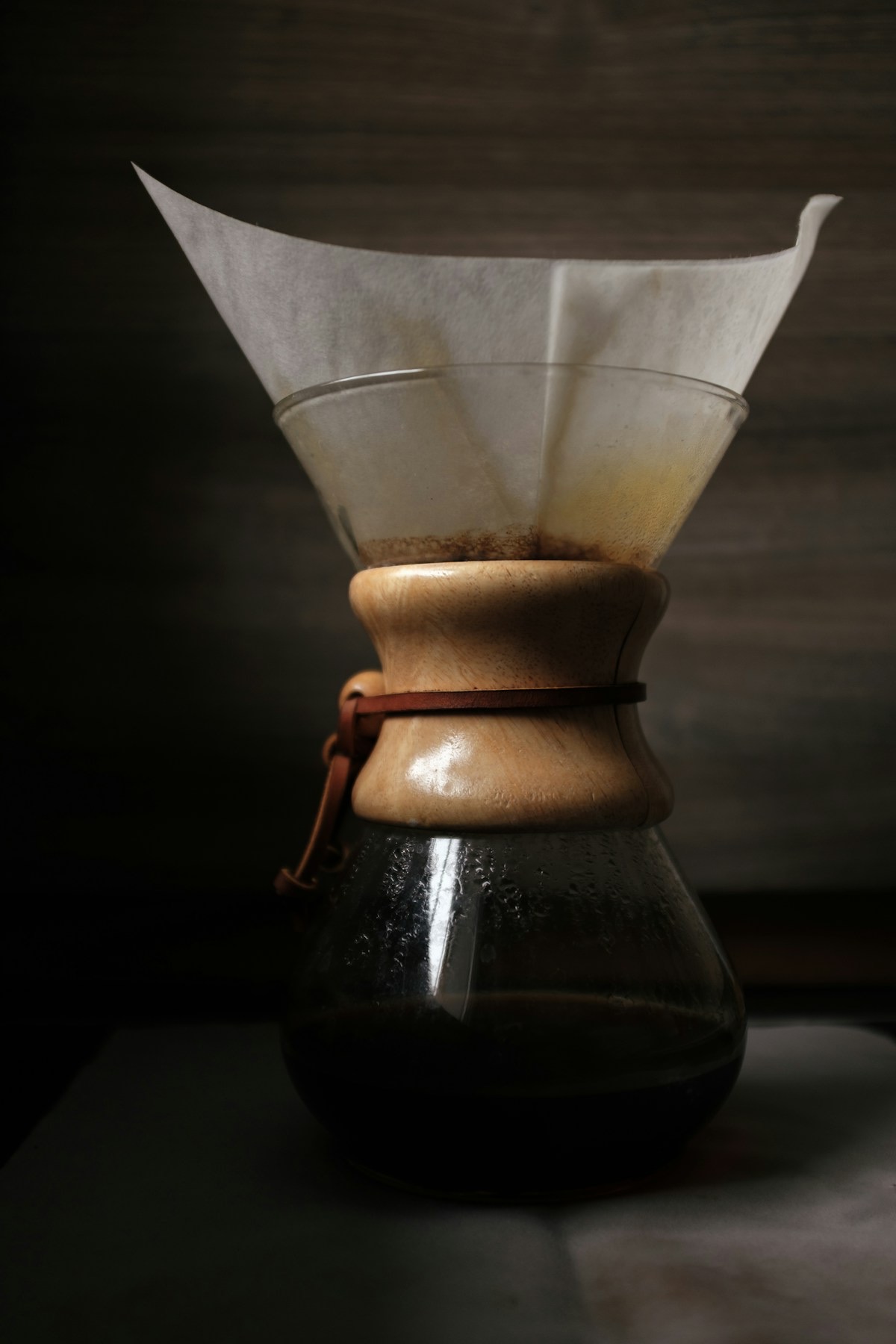
Pro tip: the groove in the spout is an air channel. As coffee drips in, air has to escape through it. If the thin side of the filter sits over the spout, wet paper can seal the groove and the brew slows to a crawl. If your Chemex stalls, check the filter before you blame the grind.
2. Grind and add the coffee
Grind 30 g of coffee medium-coarse and tip it into the filter. Give the Chemex a gentle shake to level the bed, put it on the scale and tare it to zero.
3. Bloom (0:00–0:45)
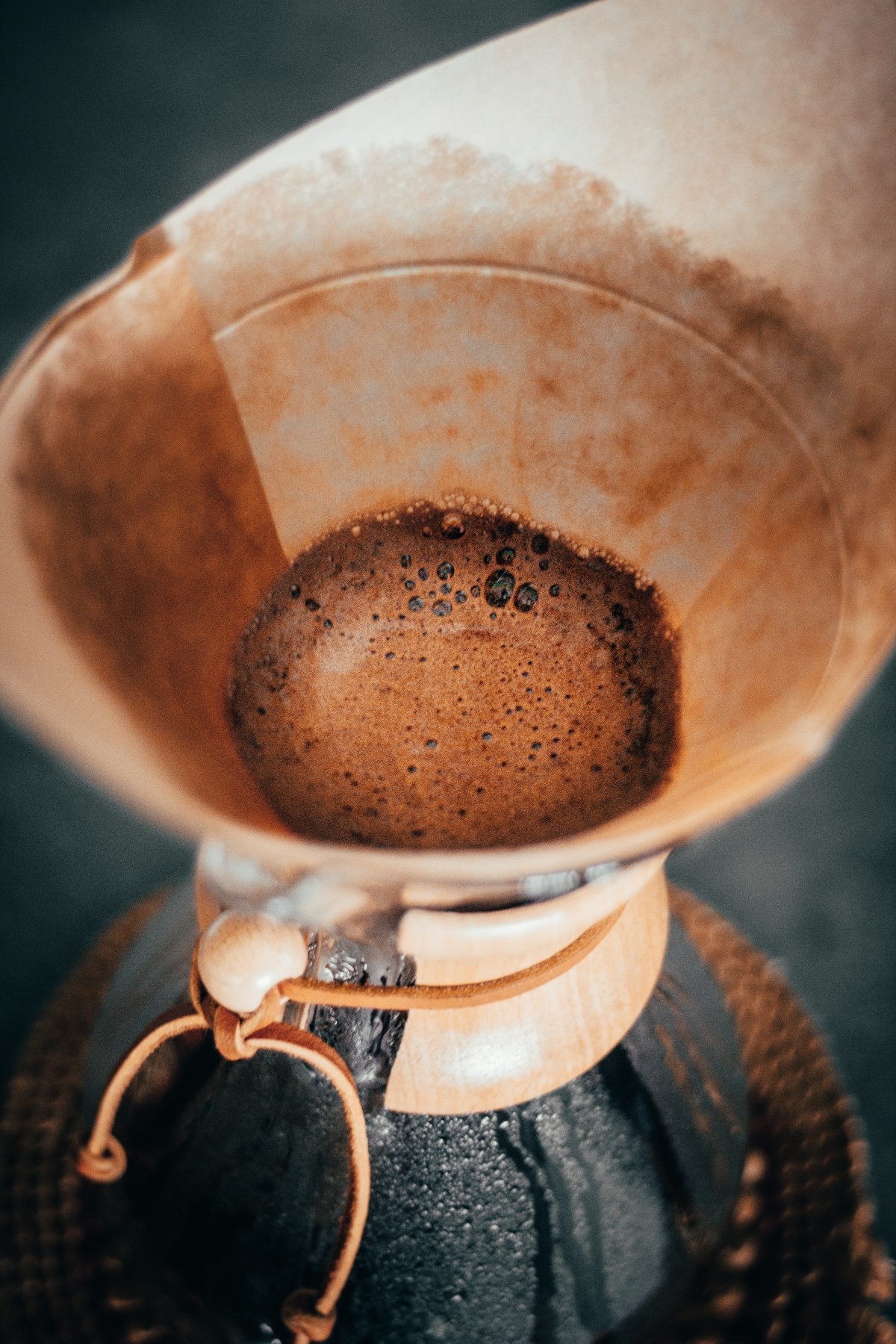
Start the timer and pour about 60 g of water, twice the weight of the coffee, so that all the grounds are wet. Swirl gently to break up any dry clumps. The bed will puff up and bubble as fresh coffee releases carbon dioxide. Without this step, the gas pushes water away and the coffee brews unevenly.
4. Pour in two stages (0:45–2:15)
At 0:45, pour slowly in small circles to 300 g. Stay in the middle and avoid pouring straight onto the paper, where water can run down the sides without touching the coffee. Keep the water level a couple of centimetres below the top of the filter. At about 1:30, pour again to 500 g. Give the Chemex one gentle swirl to flatten the bed.
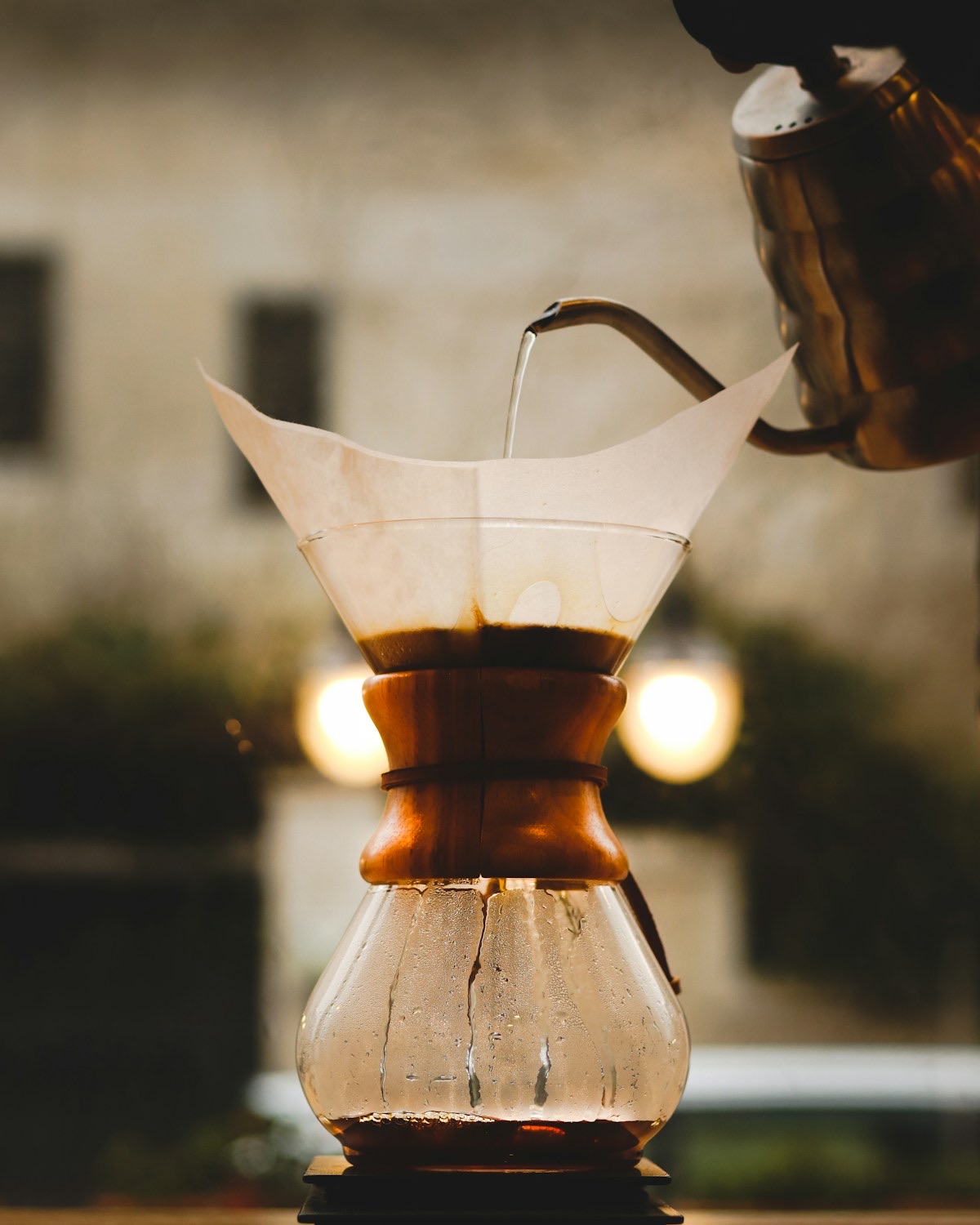
5. Let it drain and serve (about 4:00)
Let the water drain through. The bed should end up flat, without a wall of grounds stuck high on the paper. When it has stopped dripping, at around 4:00–4:30, lift out the filter and throw it into the compost. Swirl the Chemex to mix the coffee (the first and last drips taste different) and pour.
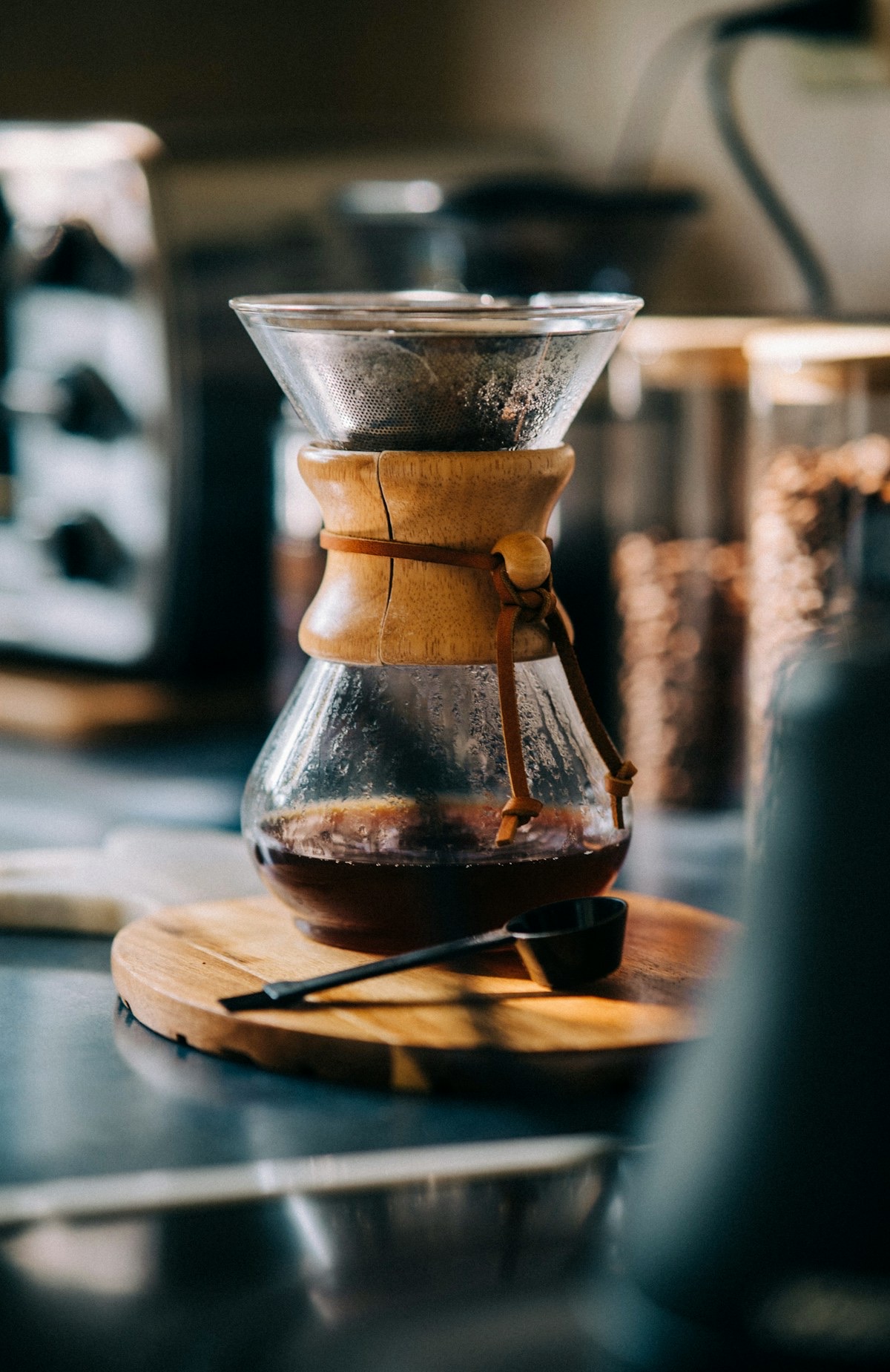
James Hoffmann’s video covers the Chemex’s history, his brewing technique and his honest opinion of it.

Troubleshooting: fix your Chemex
Check your brew time first. Change one thing at a time, and start with the grind.
| What happened | Likely cause | Try this |
|---|---|---|
| Sour, thin; drained fast | Under-extracted: grind too coarse, or water too cool | Grind finer. Use water just off the boil. |
| Bitter, drying; drained slowly | Over-extracted: grind too fine | Grind coarser. |
| Brew stalls or barely drips | Filter sealing the air channel, or fines clogging the paper | Three-layer side over the spout. Grind coarser. Pour more gently. |
| Weak or watery | Not enough coffee for the clean paper | Move from 1:17 towards 1:15. Weigh, don’t scoop. |
| Papery taste | Filter not rinsed, or not rinsed enough | Rinse with plenty of hot water, especially natural (brown) filters. |
| Coffee goes cold fast | Cold glass | Rinse with hot water first. Chemex says you can keep it warm on a low gas flame or a glass-top stove on low. Never microwave it. |
Chemex vs V60
Both are pour over, and the method is almost the same. The filter is what makes them taste different.
| Chemex | Hario V60 | |
|---|---|---|
| Filter | Thick bonded paper | Thin paper |
| Grind | Medium-coarse | Medium-fine |
| Brew time | 4–4½ min (500 g) | 3–3½ min (250 g) |
| Taste | Very clean, light body | Clean, a little more body |
| Best for | 2–4 cups, serving at the table | 1–2 cups, daily brewing |
If you mostly brew one cup, a V60 is quicker and more forgiving. Our pour over guide covers it, and the iced pour over method there works in a Chemex too. If you brew for two or more, or want the brewer to double as a serving carafe, the Chemex wins.
Chemex filters: which ones, and why they matter
Chemex bonded filters come as pre-folded squares, circles and half-moons (for the 3-cup and other small Chemex brewers). They all brew the same; the shape is down to which Chemex you have and what you prefer. White filters are cleaned in an oxygen bath; natural (brown) ones are not. Both are made without chlorine bleach and both are compostable. Natural filters need a more thorough rinse.
Can you use a regular cone filter? In a pinch, yes, but it fits badly and drains much faster, so the cup is thinner and less clean. The heavy paper is also why Chemex coffee is so low in coffee oils, including cafestol, the compound in unfiltered coffee that can raise LDL cholesterol. We explain this in our French press guide.
What coffee works best in a Chemex?
A Chemex strips away body and leaves clarity, so it rewards coffees with bright, distinct flavours: light and medium roasts, especially washed coffees from Ethiopia, Kenya or Central America. Fruity, floral notes come through really clearly. Dark roasts can taste thin and a bit hollow in a Chemex; if you prefer them, brew at 1:15 and a little cooler (about 90 °C), or use a French press.
As always, freshness matters more than origin. Brew between about 4 days and 4 weeks after the roast date.
A design classic, made by a chemist
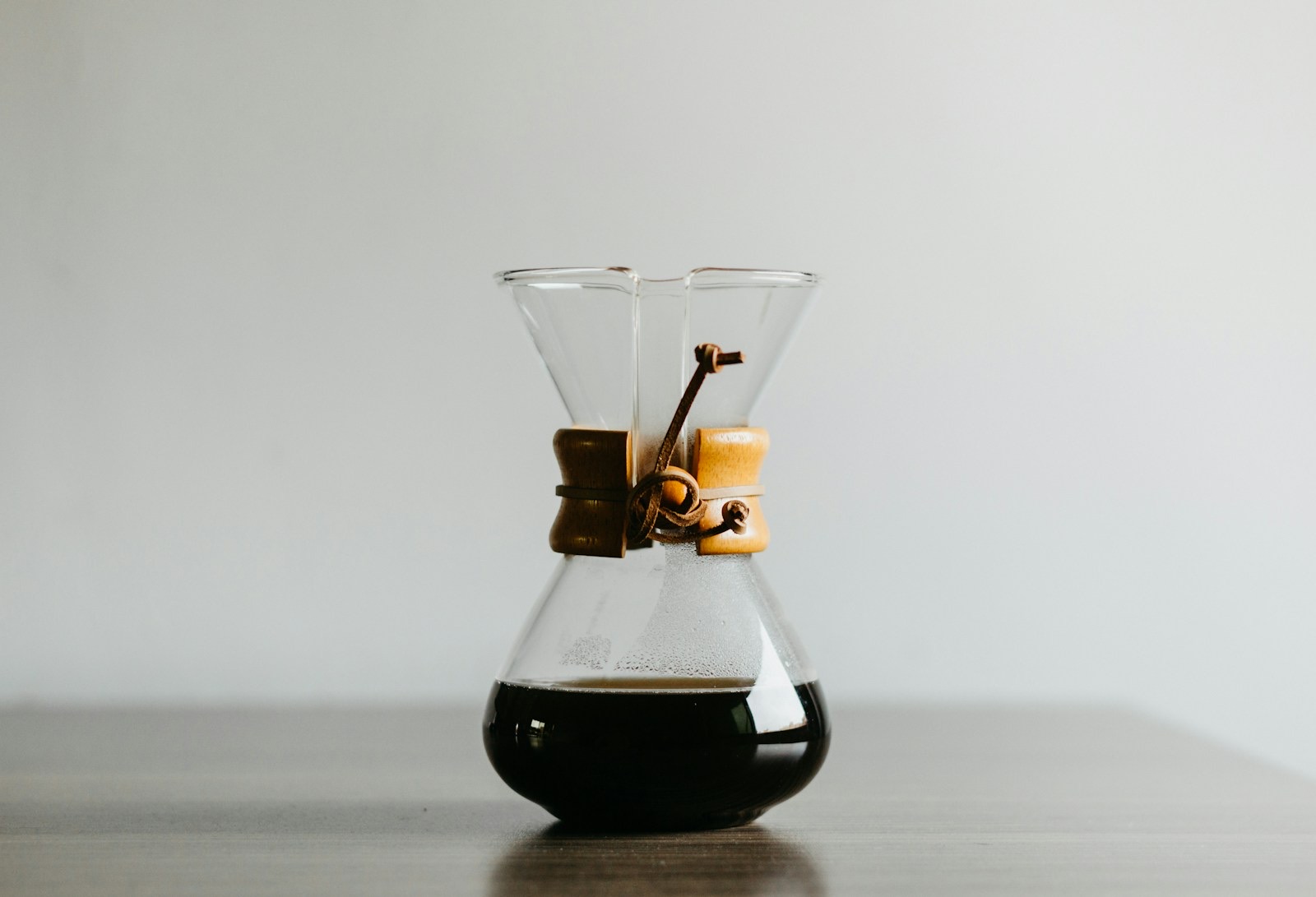
The Chemex was invented in 1941 by Peter Schlumbohm, a German chemist living in New York. He based it on two pieces of lab glassware, a glass funnel and an Erlenmeyer flask, and made it from non-porous borosilicate glass that wouldn’t add any taste of its own. The wooden collar and leather tie are there so you can hold it when it’s hot. “A coffeemaker must make coffee,” he said, “and then I applied my knowledge of physics and chemistry.”
The Museum of Modern Art in New York added a Chemex to its collection in 1943, and it is still made in almost exactly the same shape today.
Cleaning
The filter and grounds go into the compost. Rinse the Chemex with hot water after each brew. Once a week, wash it with warm soapy water and a long bottle brush, because coffee oils build up and taste stale. The glass is dishwasher safe, but on the Classic you must untie the leather tie and take off the wooden collar first. For brown stains, soak it in warm water with a little white vinegar or baking soda.
Chemex FAQ
Start at about 1:16: 30 g of coffee to 500 g of water for two mugs, or 42 g to 700 g for a full 6-cup Chemex. The thick filter makes a very clean, light cup, so if it tastes thin, go stronger (1:15) before you change anything else.
The side with three layers of paper. It’s stiffer, so it won’t collapse into the spout. The spout’s groove is an air channel; if a single layer of wet paper seals it, air can’t escape and the brew stalls.
In a pinch, but they fit poorly and are much thinner, so the coffee drains faster and tastes less clean. Chemex bonded filters are 20–30% heavier than other brands, and that paper is what gives Chemex coffee its clarity.
Usually the grind is too fine, or the filter is sealing the air channel in the spout. Grind one or two steps coarser, put the three-layer side over the spout, and pour more gently. For 500 g of water, about 4–4½ minutes is normal; a full 6-cup batch can take 5.
Yes. The 3-cup Chemex is best for a single mug: use about 20 g of coffee and 330 g of water. In a 6-cup Chemex a single cup works too, but the small bed brews fast and cools quickly, so grind a little finer.
Not by itself. Strength depends on the ratio, and at 1:16 a Chemex is about as strong as drip coffee. It often tastes lighter, because the heavy filter holds back the oils that give coffee its body. A 250 ml mug brewed with 15 g of coffee typically has roughly 100–150 mg of caffeine.
The glass is, according to Chemex, but on the Classic you have to untie the leather tie and remove the wooden collar first. Place it so it can’t knock against other dishes. Never put a Chemex in the microwave.
Sources
- Chemex, Filter Series info and support (filter orientation, white and natural paper) and FAQ (cup size, cleaning).
- Chemex, Bonded filters (20–30% heavier than other brands) and About Chemex (Peter Schlumbohm, 1941).
- The Museum of Modern Art, Peter Schlumbohm, Chemex Coffee Maker, 1941.
- Specialty Coffee Association, Coffee Standards (brewing temperature and ratios).
- Stumptown Coffee, Brew Guide: Chemex (the 3-pour recipe in our timer).
- James Hoffmann, The Chemex.
How we work: how we test · editorial policy · research & sources.
Published