Rozali Coffee Tabe Burka review: a honey-processed Guji for pour over
Rozali Coffee's Ethiopia Tabe Burka on a V60: apricot, dark honey and lemon tea. The 16 g to 250 g recipe, the Berlin roaster, price and shipping.

Written from hands-on coffee experience and checked against our editorial standards. Editorial policy · Research sources
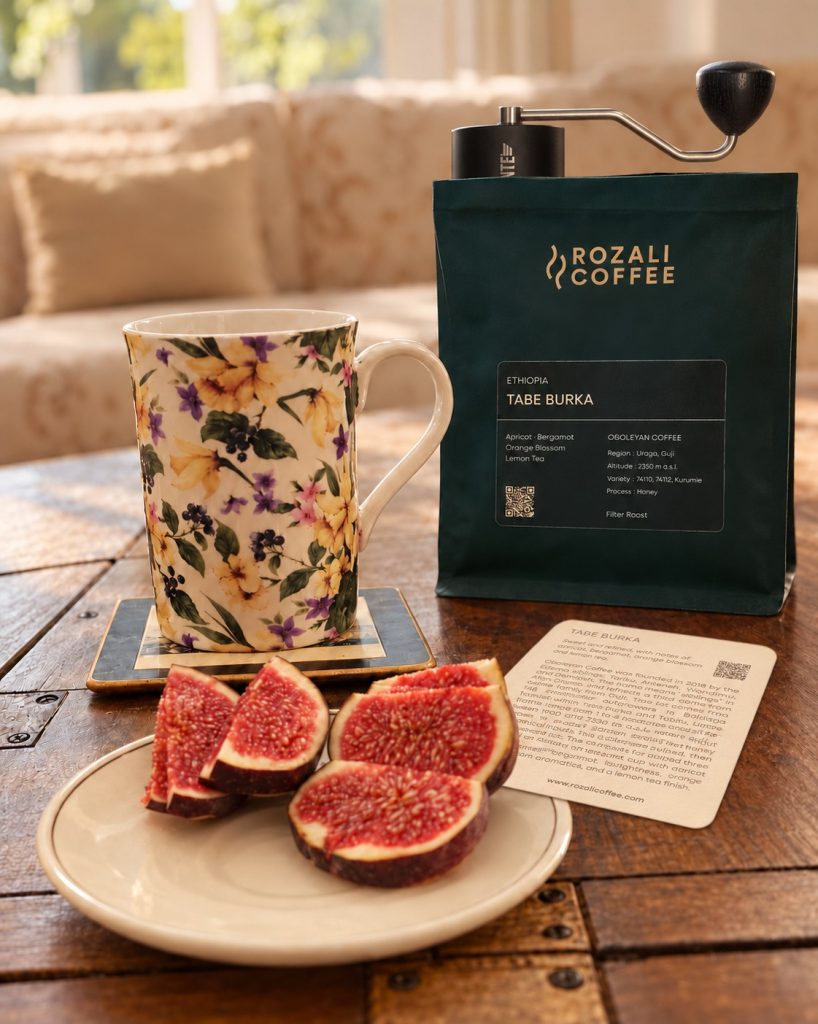
Ethiopia Tabe Burka is a honey-processed coffee from Uraga in Guji, southern Ethiopia, roasted for filter by Rozali Coffee in Berlin. In the cup it’s apricot, dark honey and lemon tea with a touch of white flowers, on a smooth, tea-like body with gentle citrus acidity. It’s an easy, sweet Ethiopian to enjoy as pour over, and the farm-level detail behind it is unusually complete. The catch for readers outside Europe is shipping from Berlin.
This is the first in a series on the coffees I drink in Rome: bags I buy in the city’s cafés or order online here. Next come European roasters by country, then roasters in the US and Canada.
How this review was done: I picked up this bag from Rozali at Nero Vaniglia, a pastry shop in Rome, in October 2026 after the barista recommended it. It was roasted on September 1, 2026, and I brewed it using a V60 and the recipe below. All the photos are my own.
- Coffee: Ethiopia Tabe Burka, Rozali Coffee (Berlin), roasted for filter.
- Origin: Oboleyan Coffee, Tabe Burka washing station, Uraga, Guji. 2,330 m (7,644 ft). Varieties 74110, 74112 and Kurume. Honey process.
- Tastes like: apricot, dark honey, white flowers and lemon tea. Medium, smooth, tea-like body; delicate citrus acidity; a medium-length honeyed finish.
- Recipe: V60, 16 g coffee to 250 g water (1:15.6), 92 °C (198 °F), Comandante C40 MK3 at 24 clicks, 2:30–2:40 total.
- Price: €18 for 200 g, €81 for 1 kg on Rozali’s site (October 2026). Shipping €5.90 in Germany, €7.50 to €12.50 in most of Europe, €25 to the US on orders under €65.
Pros
- Sweet, clean cup: apricot and dark honey
- Smooth, tea-like body with gentle citrus acidity
- Full traceability: producer, washing station, varieties and altitude on the bag
- A pocket on the bag holds a card with the full lot story
Cons
- Shipping adds up on small orders: €7.50 to €12.50 across most of Europe, €25 to the US and Canada under €65
- A single seasonal lot, so it won’t be on sale year-round. If it sounds like your kind of coffee, buy it while it’s in stock
Who should buy Tabe Burka, and who shouldn’t
Buy it if you brew pour over and like Ethiopian coffee on the gentle side: fruit and honey sweetness, a tea-like texture and acidity that stays soft. It also suits anyone who wants to know exactly where a coffee comes from, down to the hamlet and the varieties.
Skip it if you mostly drink espresso or milk drinks. This is a filter roast, and Rozali sells a separate espresso selection. Skip it too if you want a heavy, chocolatey cup; this one is medium-bodied and tea-like. Our best coffee beans list has other picks.
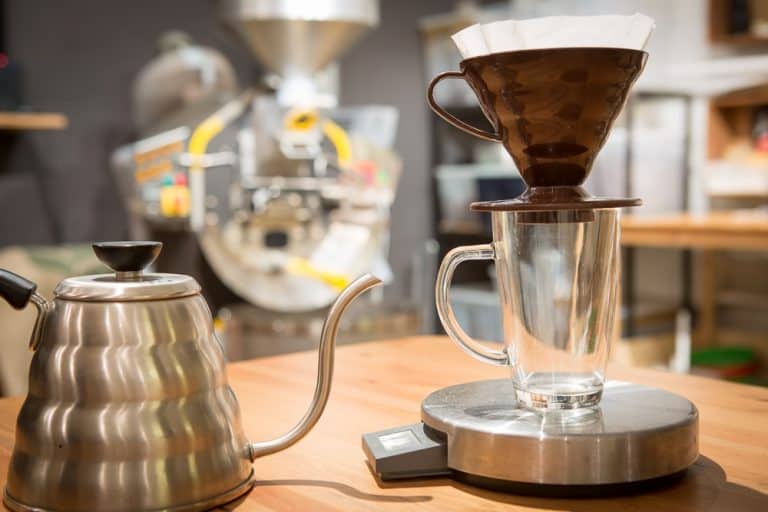
How I brewed it: my V60 recipe
I brewed Tabe Burka with this recipe: 16 g of coffee to 250 g of water, a ratio of about 1:15.6. That’s at the stronger end of the 1:15 to 1:17 range in our pour over guide, where the cup is fuller and stronger.
- Brewer: Hario V60.
- Grinder: Comandante C40 MK3 at 24 clicks, counted from zero (burrs touching). That’s medium-fine, like fine sand.
- Water: 92 °C (198 °F).
- Total time: 2:30–2:40, including drawdown.
| Time | Pour | Scale reads | How |
|---|---|---|---|
| 0:00–0:10 | 50 g | 50 g | Bloom: wet all the grounds |
| 0:30–0:45 | 100 g | 150 g | Fast, high pour with lots of turbulence |
| 1:00–1:30 | 100 g | 250 g | Slow, gentle pour |
| 2:30–2:40 | – | 250 g | Drawdown finished |
The bloom is about three times the coffee’s weight, enough to soak every particle so the gas from roasting can escape. The second pour is fast and turbulent to stir the bed; the last is slow so the bed settles flat and drains evenly. If your brew runs well past 2:40, go one or two clicks coarser; if it finishes before 2:30, go one or two finer.
Our coffee-to-water ratio calculator scales the recipe up for two cups.
Rozali publishes its own V60 recipe: 16 g of coffee to 230 g of water at 93 °C (199 °F), about 22 clicks on a Comandante, finishing at 2:20–2:40. Mine uses the same dose with 20 g more water, a degree cooler and two clicks coarser.
How Tabe Burka tastes
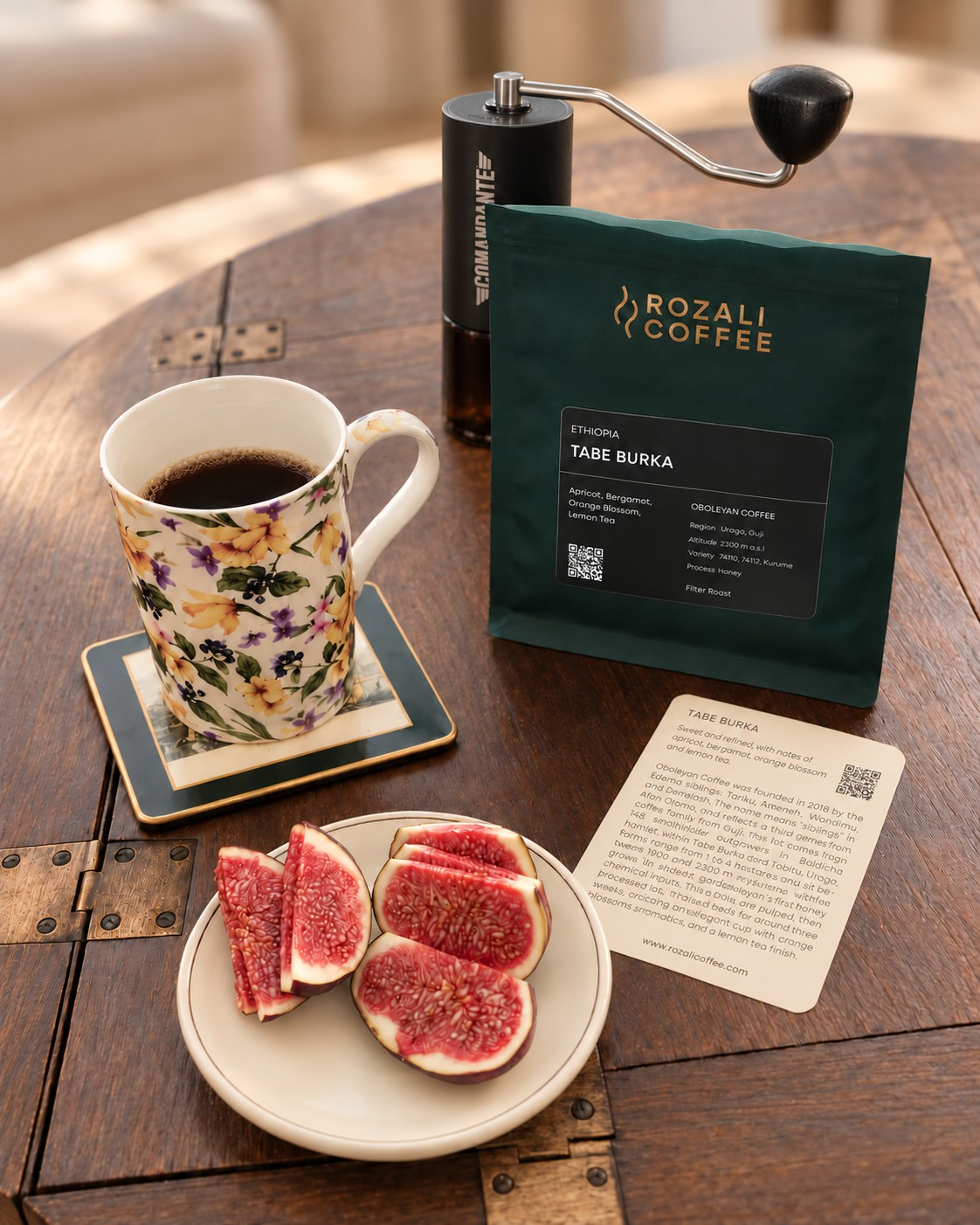
I really liked this coffee and looked forward to brewing it. There was nothing in the cup I didn’t like: to me it’s the classic, familiar taste of Ethiopian coffee, the kind I love most. I tasted apricot, dark honey and lemon tea, with a light note of white flowers. It was smooth and tea-like, with a gentle citrus brightness and a honey sweetness that stayed for a little while after each sip.
| Aroma and flavor | Apricot, dark honey, white flowers, lemon tea |
| Acidity | Delicate, citrus |
| Body | Medium weight, smooth, tea-like |
| Finish | Medium length, honeyed |
Rozali’s notes on the bag are apricot, bergamot, orange blossom and lemon tea. Apricot and lemon tea matched what I found. Where Rozali lists bergamot and orange blossom, I tasted dark honey and white flowers.
The bag and the lot card
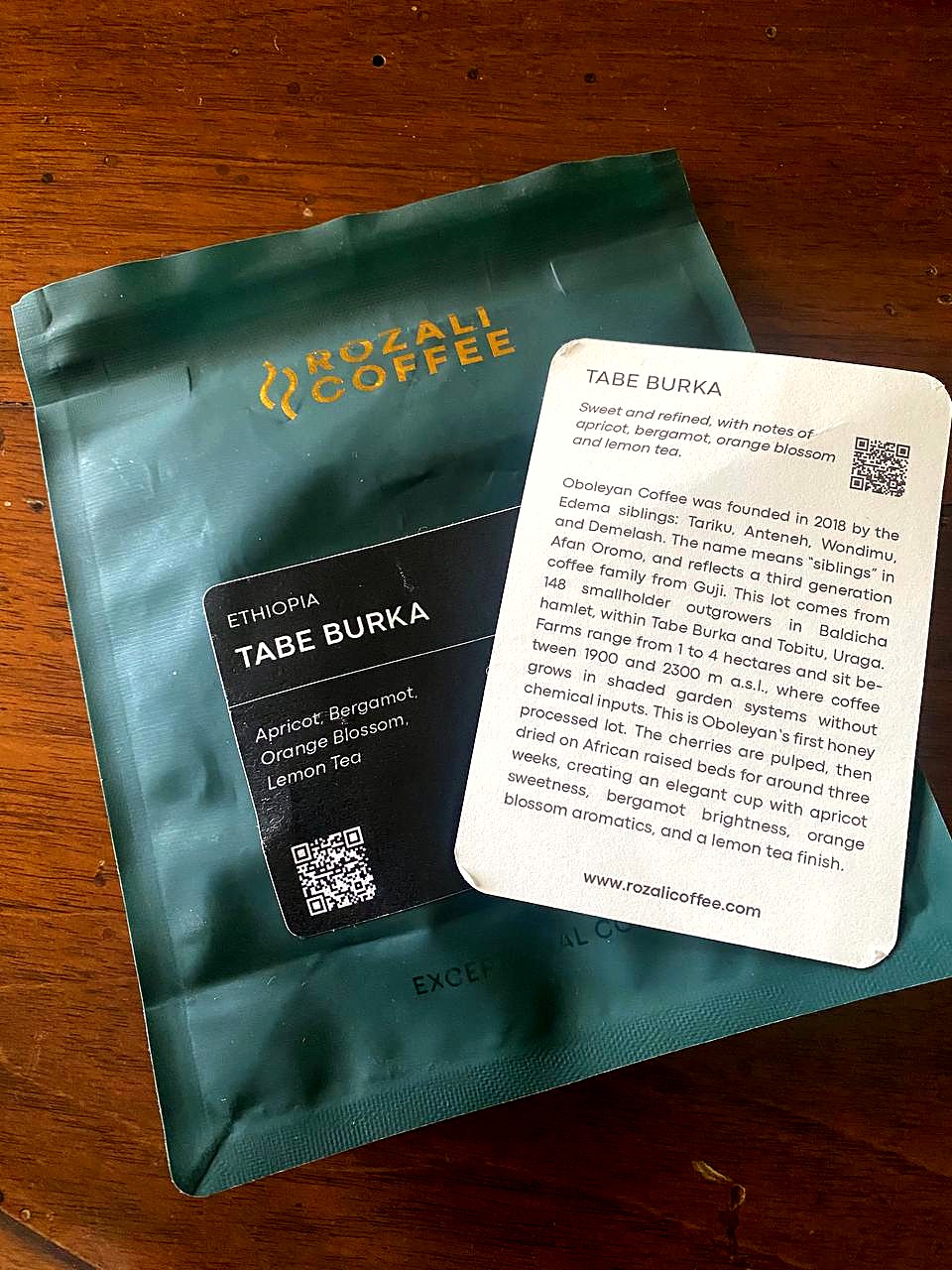
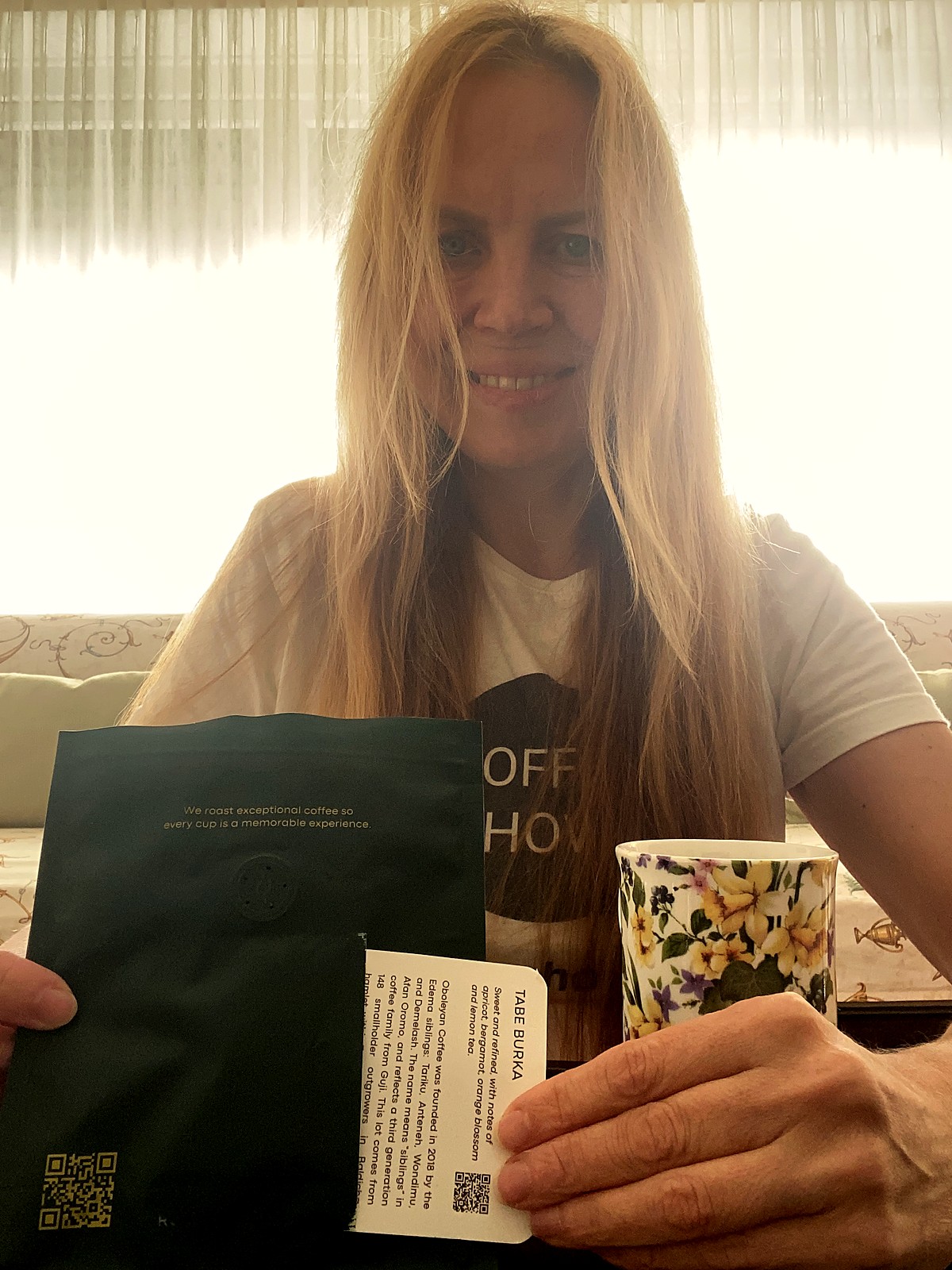
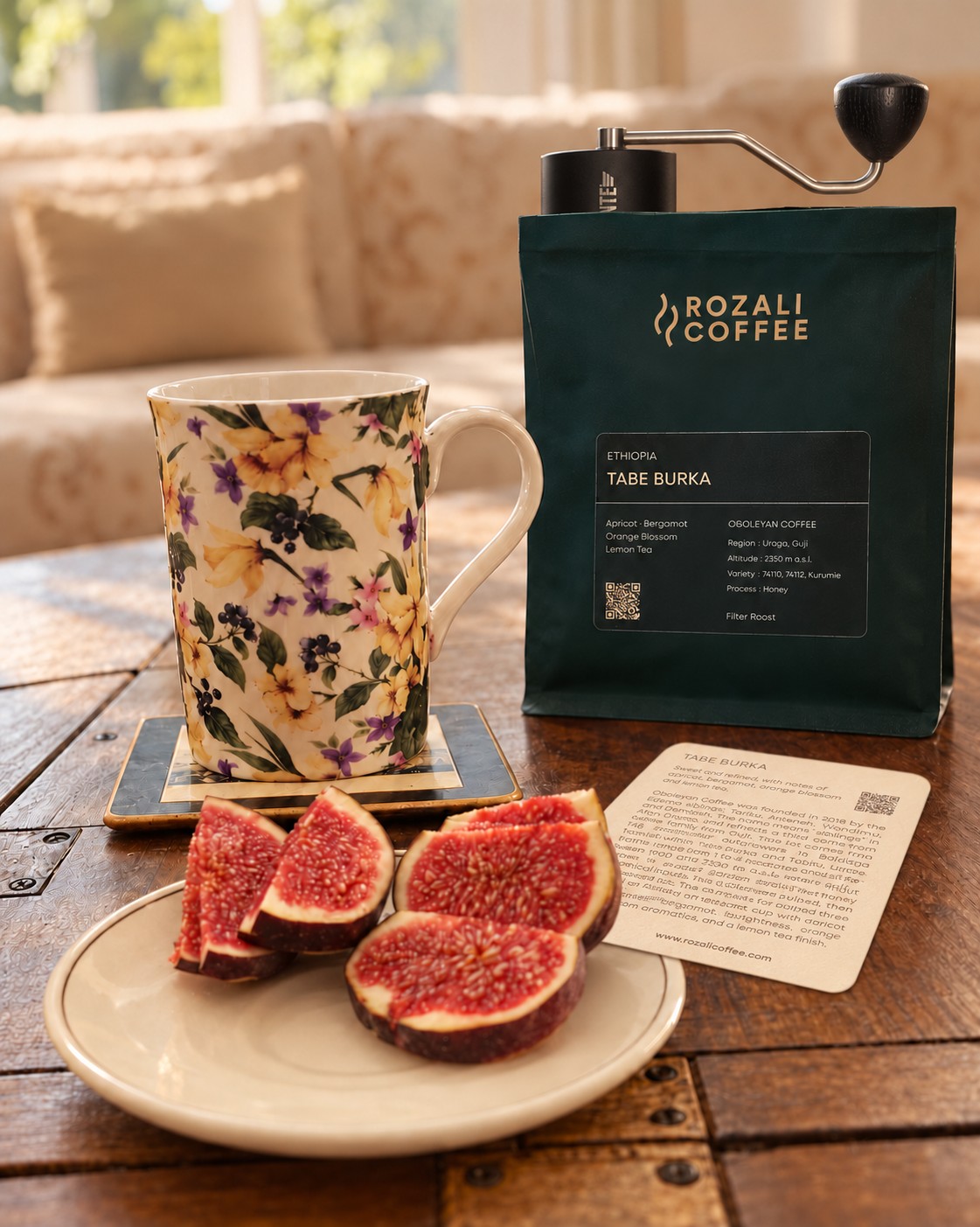
Tabe Burka comes in a matte green pouch with a one-way valve. The front label lists the origin and tasting notes, along with a QR code. On the back, a small pocket holds a card with more about the coffee: the producer, the farms, the altitude and how it was processed. I love this little detail: it’s nice to pull out the card and read the story behind what’s in my cup.
About the roaster: Rozali Coffee, Berlin
Rozali Coffee is a small specialty roaster in Berlin, founded by David Rozali. His story, as told on the brand’s own founder page, starts far from Berlin: he was born in Yogyakarta, grew up in Kupang in eastern Indonesia, and moved to Australia in 2006 to study.
Until then his only coffee was Nescafé instant. That changed in 2008 with his first barista job and an espresso at a training course that was “sweet, creamy” with “a hint of pleasant bitterness”. While studying accounting and finance in Sydney and working as a tax accountant, he kept a weekend barista job, then worked full-time as a barista and roaster at Circa Espresso in Parramatta.
In 2015 he passed the Q Grader course in Melbourne, the Coffee Quality Institute’s exam for professional coffee tasters: 4 of the 24 people on his course passed. He moved to Germany in 2016, started as a barista at The Barn in Berlin in January 2017, and a month later became its head roaster and head of production.
At The Barn he noticed two things, Rozali says: many people were surprised that coffee could taste good without milk and sugar, and many were afraid of ruining an expensive bag when they brewed it. He also saw few good specialty cafés and roasters in smaller German cities such as Leipzig and Dresden. Rozali Coffee was his answer, started with €8,000 he raised for the project.
Today the brand describes its approach as “careful sourcing, thoughtful roasting, and respect for the raw material”, roasting in small batches with a focus on “clarity, balance, and consistency”. The shop splits its coffees into filter and espresso selections, plus origin editions, rarer “exceptional lots”, tasting sets and a subscription, and it ships across Europe and worldwide. Finding a coffee like this in a neighborhood pastry shop in Rome was a nice surprise.
Where the coffee comes from: Oboleyan Coffee, Guji
Rozali publishes the full lot story on its Tabe Burka page and prints a shorter version on the card in the bag. Everything in this section comes from Rozali.
The producer: Oboleyan Coffee
Oboleyan Coffee was founded in 2018 by the Edema siblings: Tariku, Anteneh, Wondimu and Demelash. “Oboleyan” means “siblings” in Afan Oromo, the language of the Oromo people. Tariku and Anteneh are the third generation of a Guji coffee family and carry on the work their father built in the region’s coffee sector.
The farms: Baldicha hamlet, Uraga
The lot comes from Baldicha hamlet, within the Tabe Burka and Tobitu kebeles (villages) of Uraga, in Guji. Oboleyan buys cherries from 148 smallholder outgrowers, farmers who grow on their own land and sell their cherries to the washing station. Their farms cover 1 to 4 hectares (2.5 to 10 acres).
The farms sit between 1,900 and 2,300 m (6,230–7,550 ft), most of them at 2,000–2,200 m (6,560–7,220 ft). The bag gives 2,330 m (7,644 ft). Coffee grows in a traditional garden system, among shade trees and other crops, with agroecological methods and no chemical inputs.
The varieties: Kurume, 74110 and 74112
Kurume is one of the traditional varieties of Guji and Gedeo, the zone that includes Yirgacheffe. Rozali explains that these regional landraces were selected over generations by farmers in Ethiopia’s rainforest highlands and are often named after native shade trees. Before it named a coffee, Kurume was the local name for Albizia gummifera, a tree that grows in the region.
74110 and 74112 are selections from the Jimma Agricultural Research Center. 74110 originally comes from Metu in Illubabor, and is valued for cup quality, yield and resistance to coffee leaf rust and coffee berry disease, two of the main diseases of the coffee plant. Rozali credits the mix with floral aromatics, high-altitude brightness and layered fruit sweetness.
The process: Oboleyan’s first honey lot
This is the first honey-processed lot Oboleyan has produced. Honey process means the cherry skin is removed but part of the sticky fruit layer, the mucilage, stays on the bean while it dries. The cherries are pulped, then dried on African raised beds, mesh tables that let air reach the beans from all sides, for about three weeks.
According to Rozali, the dry harvest season and the height of the wet mill, above 2,000 m (6,560 ft), make for slow, even drying. Keeping part of the mucilage adds sweetness, texture and a rounder fruit character, while keeping the clarity expected from high-grown Guji coffee. Rozali sums up the cup as apricot sweetness, bergamot brightness, orange blossom aromatics and a lemon tea finish.
Our Ethiopian coffee guide covers Guji and the country’s other growing regions.
Price and where to buy
Rozali sells Tabe Burka on its own site at €18 for 200 g (7 oz), or €81 for 1 kg (2.2 lb), checked in October 2026. Shipping from Berlin depends on the country. In Germany it’s €5.90, free over €30. Italy, France, the Netherlands, Austria, Belgium, Denmark, Luxembourg and Poland pay €7.50, Spain €9.50 and the UK €11.50, all free over €95. Most other European countries, including Portugal, Greece, Ireland, Sweden and Switzerland, pay €12.50 under €65, €8.50 up to €110, then nothing. To the US and Canada it’s €25 under €65, €15 up to €200, then free. In Rome I bought mine at Nero Vaniglia, which stocks beans from several European roasters.
Tabe Burka at a glance
| Roaster | Rozali Coffee, Berlin |
| Coffee | Ethiopia Tabe Burka |
| Producer | Oboleyan Coffee |
| Washing station | Tabe Burka |
| Region | Uraga, Guji, Ethiopia |
| Altitude | 2,330 m (7,644 ft) |
| Varieties | 74110, 74112, Kurume |
| Process | Honey |
| Roast | Filter |
| Roaster’s notes | Apricot, bergamot, orange blossom, lemon tea |
| Bag sizes | 200 g (7 oz), 1 kg (2.2 lb) |
FAQ
Apricot, dark honey, white flowers and lemon tea, with a smooth, tea-like body, delicate citrus acidity and a honeyed finish. Rozali’s own notes are apricot, bergamot, orange blossom and lemon tea.
On a V60: 16 g of coffee to 250 g of water at 92 °C (198 °F), ground at 24 clicks on a Comandante C40 MK3. Bloom with 50 g, pour 100 g fast at 0:30, then 100 g slowly at 1:00. Total time 2:30–2:40.
It’s roasted for filter, so it suits pour over, batch brew and other filter methods better. Rozali sells a separate espresso selection roasted for espresso machines.
The cherry skin is removed, but part of the sticky fruit layer stays on the bean while it dries. Coffees processed this way tend to be sweeter and rounder than washed coffees from the same area. Tabe Burka dried on raised beds for about three weeks.
David Rozali, an Indonesian-born Q Grader who was head roaster and head of production at The Barn in Berlin from 2017. He started Rozali Coffee in Berlin to bring well-roasted specialty coffee, and clear advice on brewing it, to more German homes.
Yes. In October 2026 shipping from Berlin to the US and Canada cost €25 on orders under €65, €15 from €65 to €200, and nothing above €200. Within Europe it’s cheaper: €5.90 in Germany, €7.50 to Italy or France and €12.50 to most other countries, free over €30 in Germany and over €95 or €110 elsewhere.
24 clicks from zero on a Comandante C40 MK3 is a good start for a 16 g V60. Go one or two clicks coarser if the brew runs long, finer if it finishes early. Count clicks from the point where the burrs just touch.
Sources
- Rozali Coffee, Tabe Burka (lot details, producer, prices), checked October 2026.
- Rozali Coffee, Meet David, the Founder of Rozali Coffee, February 2021.
- Rozali Coffee, About Rozali Coffee, Filter Brew Guide and Shipping and delivery, checked October 2026.
How we work: how we test · editorial policy · research & sources.
Published